
Situated in Armidale in New South Wales, the New England Regional Art Museum (NERAM) is a lively part of town. Since moving to this area a few months ago, I’ve found myself visiting the museum time and time again for exhibition openings, live music, and to meet up with new friends in the café.
The museum was begun in 1983 as a gallery for the Howard Hinton Collection and today a selection of 132 of its works are on permanent display in one of the galleries. A long wall text explains its history and the background of the collector, while the gold framed works line the gallery’s deep blue painted walls. The text calls out the minimal representation of women and indigenous artists within this collection and, quite traditionally, focuses on what one can learn about the personality of the collector through the works he bought and then donated. A case at the centre of the gallery contains some documents and objects that further illustrate the history of the collection within the context of the town. Since the original collection, the museum has expanded its holdings to over five thousand works and now has a busy calendar of exhibitions, events, and school programs throughout the year.
When I visited for the purposes of writing this blog post, there were three temporary exhibitions on display in the other galleries. The first was Angel Time, a collaboration between contemporary artist Angus Nivison and writer Sophie Masson. The opening panel described how the artist created works inspired by one of Masson’s novels and she, in turn, wrote poetry inspired by his works. The exhibition walls featured lines from her poems and a multimedia element through QR codes allowed visitors to listen to Masson reading excerpts from her book. The other smaller exhibition on at the museum at this time is Winter Wonderland which featured a selection of works from the NERAM collections related to the season. Though I’m told that actual snow is a rare sight in Armidale, the chilly white painted landscapes of some of the works in the exhibition did remind of the real frost outside.
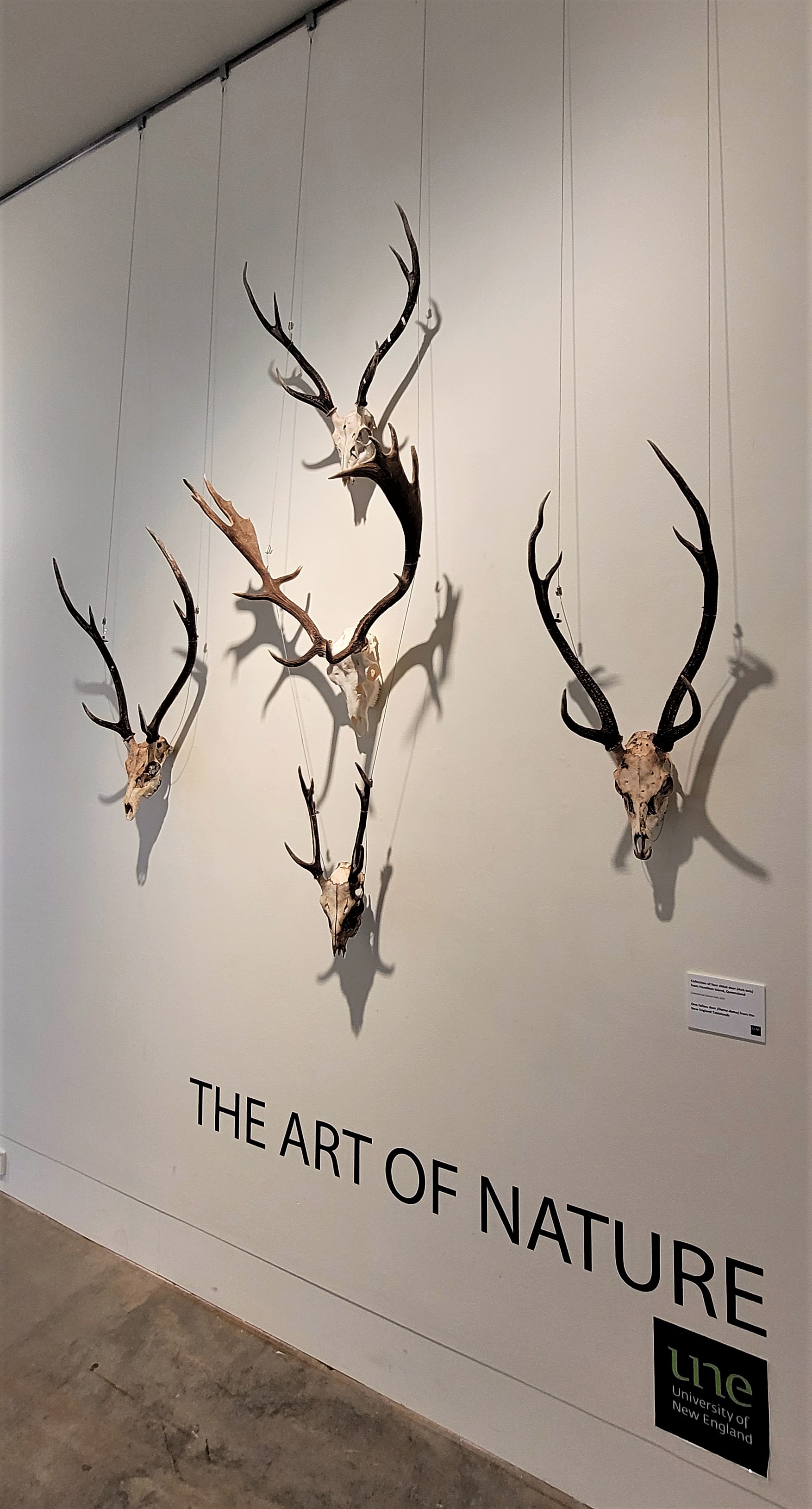
The largest gallery was home to The Art of Nature, a collaborative exhibition between NERAM and the Natural History Museum at the University of New England. This combined animal specimens from the collections of the latter with art from the former. The opening text explained how art can be found in nature: in the spiral of snail shells, in the colours of butterfly wings, in feathers, in reptile scales. Nature can also inspire art.
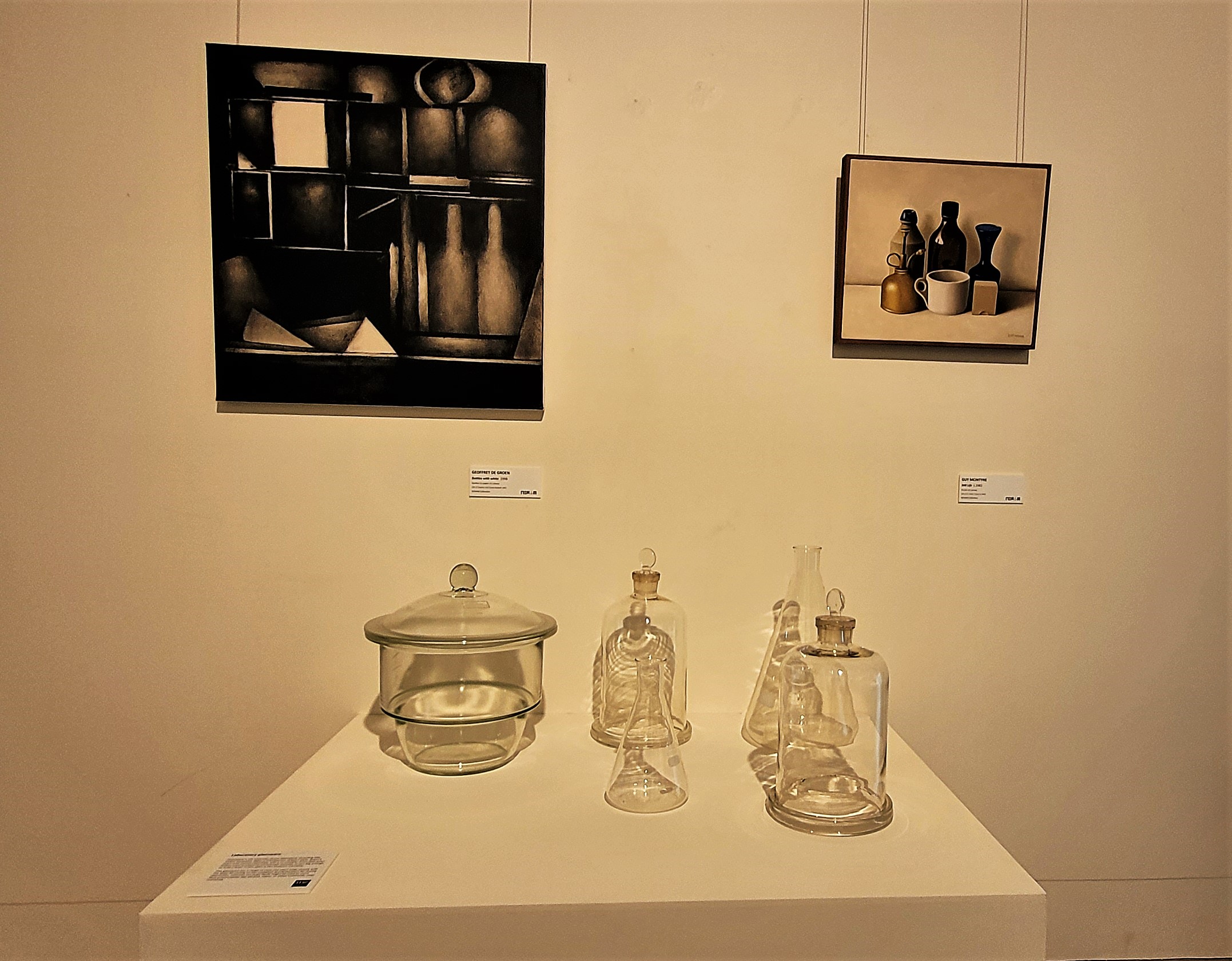
The connections between the two collections and the worlds of art and science ranged from the explicit to the whispered. Deer skulls were extended across the opening stark white wall by their long antlers and the crisp shadows they cast. Nearby the rounded forms of laboratory glass reflected the gallery’s lights, while a painting of black and grey forms by Geoffrey de Groen worked to swallow them. Pictured at top, a python reticulatus enveloped a branch, its long body full of waves and curls, while nearby a painted red belly black snake stretched and directed your eye across the long parched and flaming canvas of Tim Storrier’s Incendiary Plateau (Red Belly Black) and the Noon Line (1992).
Many of the natural specimens were exhibited en masse, with many tiny forms displayed, labelled, and arranged, reminding visitors of the Wunderkammer, the storeroom, and the lab. The art, on the other hand, with its mixture of sizes and frame styles, helped remind of the unruly variety of the natural world and human interactions with it, not always easily contained and organised. Within the paintings are the effects on nature of our continued presence: a fish lies on a dinner plate, dogs are walked on leads, and butterflies flutter around a dress’ printed flowers.
Wandering around I was struck how the bright colours of much of the art and many of the specimens were juxtaposed with many animal skeletons. These repeated assemblages of bones were sometimes arranged on branches themselves, left as the echo of the animals they used to be and their textures finding links to more abstract forms in art such as in Elwyn Lynn’s Black Quadrant (1969). Not all specimens once drew breath, however, as geological examples lined one corner and also found visual connections to works such as Marika Varady’s Reflections of another city (1993).

The exhibition was an interesting visit and a nice example of an inventive collaboration between art and science, two worlds that are not so far apart. If we go back through the history of museums, it seems that we have gone full circle from the cabinets of wonder that collected everything, natural and not, past the separation of disciplines that gave us art galleries and science centres, and back, full STEAM ahead, into the mix that blurs the boundaries again. I hope the creative and intellectual opportunities that this affords continue to find space on gallery floors and in curators’ conversations.

The museum is open every day except Mondays and is free to enter, with a café and a gift shop full of art books and local souvenirs. I know I will be visiting often in the future.
Museum website: https://www.neram.com.au/
* * *
Dr Alina Kozlovski is the newly-appointed Lecturer of Digital Innovation (Ancient History and Archaeology) at the University of New England. Prior to this role, she received her PhD at the University of Cambridge and worked in curatorial, education, and collections roles in museums around the world including the J. Paul Getty Museum and the Santa Barbara Museum of Art in California, the Museum of Classical Archaeology in Cambridge, and the Powerhouse Museum and the Nicholson Museum in Sydney. She has completed archaeological fieldwork in Italy, Cyprus, and the UK and her research focuses on concepts and histories of curation, starting from ancient Greece and Rome to the contemporary world.