
The youth and early career of artist, writer, theoretician, critic and translator Karel Teige was the focus of a temporary exhibition at Prague’s Museum of Czech Literature, which owns the entire collection of black notebooks he used as diaries. Teige had been a leader of the Czechoslovak avant-garde movement during the interwar years. His influence on Czech culture was immense. He also made a name for himself as a photographer, typographer and book designer, for instance.
Through the artifacts and descriptions displayed, I came to know how Teige had developed into a prominent figure of the avant-garde movement at a time when he was forming his own unique identity culturally and politically. While the exhibition is held in a small space, the displays of manuscripts, correspondence, photos and art provide great insight into Teige’s youth and adulthood.
A Prague native born in 1900, Teige spent his childhood living in the Austro-Hungarian Empire, where German was the official language. Democratic Czechoslovakia was created when he was 18 years old. Teige began writing his intriguing diaries at the age of 12, during his second year of an eight-year school program.
While his initial entries included many everyday activities, he also described historical events, such as the inauguration of the monument to František Palacký, a Czech historian and politician in the 19th century and one of the most important figures in Czech history. Even as a youth Teige delved into photography and drawing. He was a voracious reader of Czech and world literature. Greatly influenced by the modern trends of Cubism, Expressionism and Futurism, Teige was also was an avid writer during these formative years.
Teige was prolific in his late teens. Not only did he add numerous paintings, drawings and prints to his résumé, but he also published in influential periodicals and contributed to a major art exhibition that included the works of many stellar Czech artists. Teige met many prominent Czech artists at this time.
As a teenager his political views underwent a transformation. He lost his nationalistic fervor and became very left-oriented. No longer a democrat, Teige tirelessly promoted socialism.
After the war, Teige studied aesthetics and history at Charles University. During 1920, he co-founded an artistic union called Devětsil, a group that would immensely contribute to the avant-garde movement in Czechoslovakia.
Poet Jaroslav Seifert was another leading member of Devětsil. Teige and Seifert became good friends, sometimes even traveling together. Devoting much time to book design from his twenties, Teige even created avant-garde book covers for some of Seifert’s books. (In 1984 Seifert won the Nobel Prize for Literature.) Teige’s covers and illustrations were works of art in themselves. His ventures into typography at this time also received much recognition.
During the first half of the 1920s, Teige was greatly influenced by his travels throughout Europe. He went to Paris twice and met with Le Corbusier and Man Ray, for instance. After World War I his impressions in France inspired him to found the Poetism movement in the Czech lands. Acting as a sort of catharsis from the horrors of war, Poetism emphasized ordinary events with a sense of optimism.
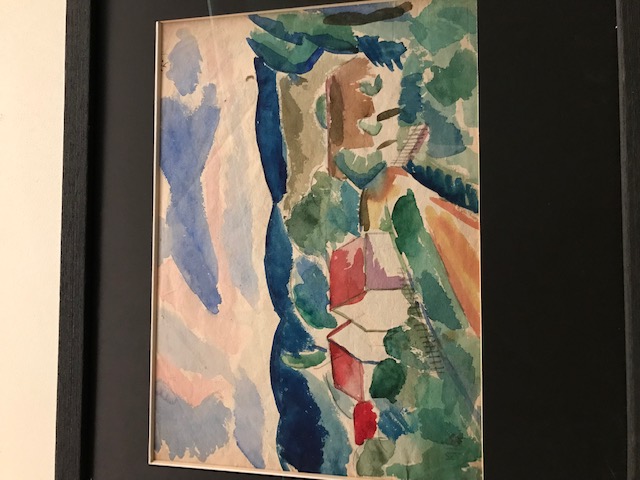
Teige’s early artwork is a highlight of the exhibition. His paintings feature strong colors, reflecting the influence of Fauvism. I noted the peacefulness of a scene depicting two red-roofed houses, gentle hills in the background and a dirt road leading into the horizon. The houses are rendered in simple, geometric forms, bringing Cubist elements to mind.
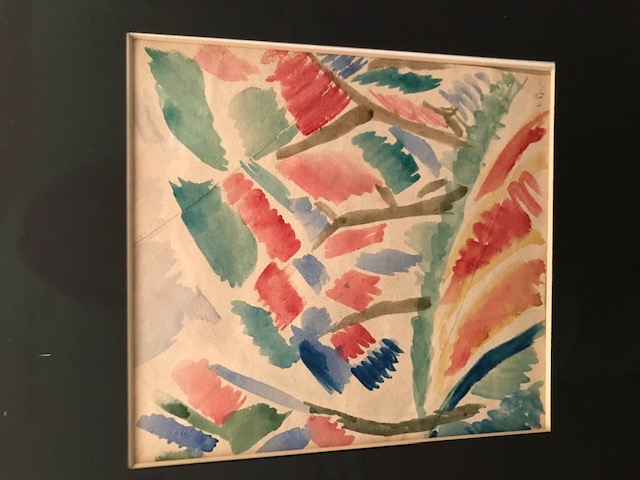
I was struck by another of Teige’s paintings characterized by bright colors. It featured simple, broken up and geometric shapes in green, red and blue, making up trees in an unrealistic fashion. Again, I noted the influences of Cubism and Fauvism.
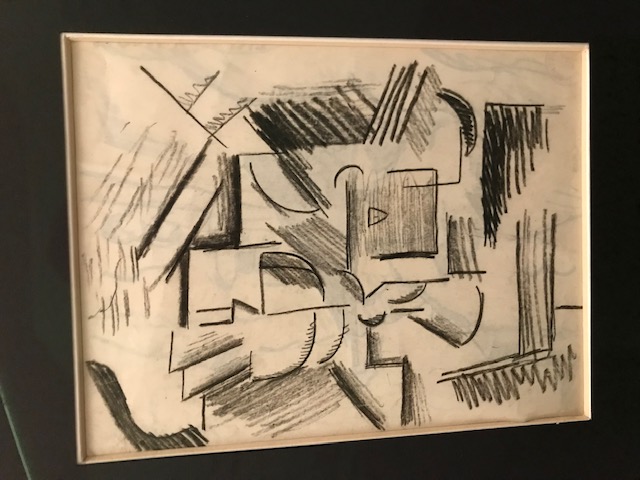
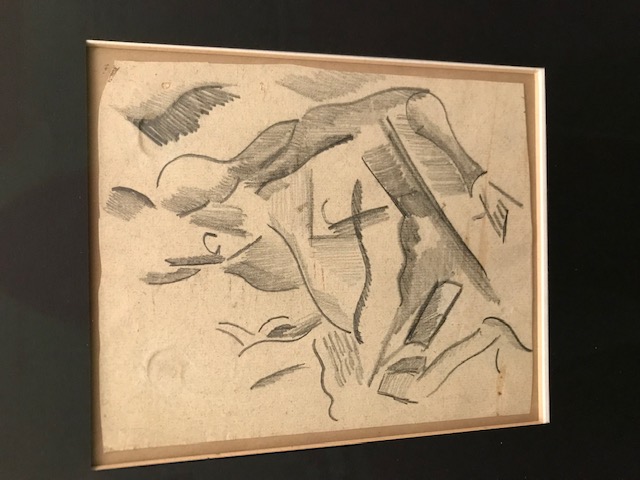
However, two of Teige’s black-and-white drawings made a different impression on me. While they utilized simple, geometric forms, I sensed the impersonalization of the modern, mechanical world.
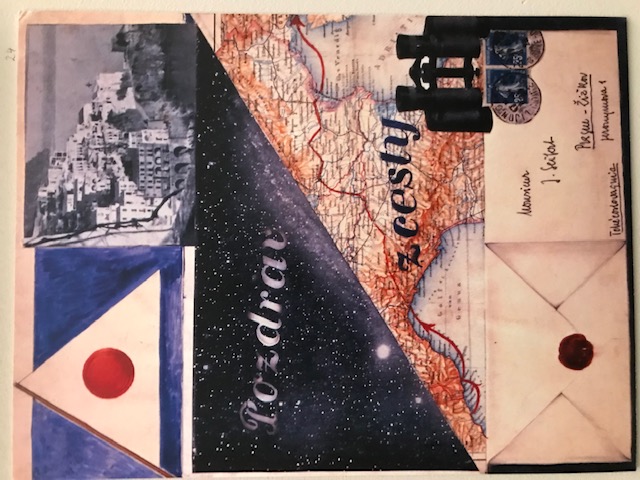
As a travel writer, I have always been interested in works by Teige that have a travel-related theme. One of my favorite artworks by Teige is a picture poem called “Greetings from the Journey.” This visual poem of objects associated with traveling features a black-and-white picture of a romantic coastline reminiscent of the Amalfi Coast; a pair of binoculars; the capitalized word “Pozdrav” (greeting in English) against a background of a star-studded, pitch black sky; and the words “z cesty” (from the journey in English) appearing over a map. Geometric symbols also are depicted. The bottom of the painting shows a stamped envelope addressed to Seifert. I sensed a contagious enthusiasm for traveling while perusing this picture poem that utilized geometric shapes and montage elements found in Poetism trends.
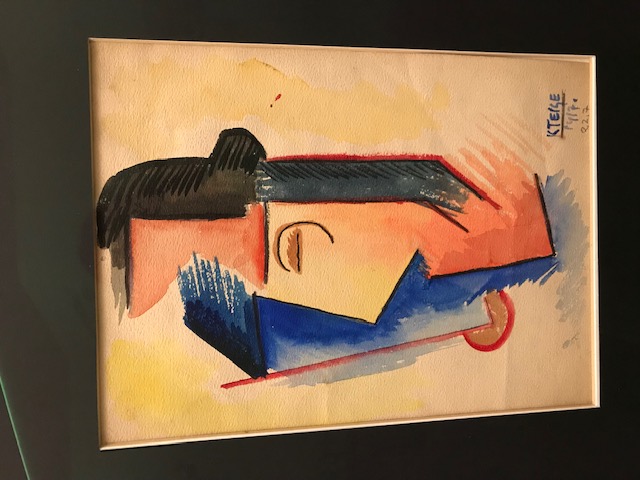
A watercolor dubbed “Portrait of a Traveler” shows a figure with red and blue hues. The cheerful colors evoke traits of Fauvism as well as optimism, enthusiasm and vibrant energy. It is definitely a portrait of a man who has stories to tell, experiences to share.
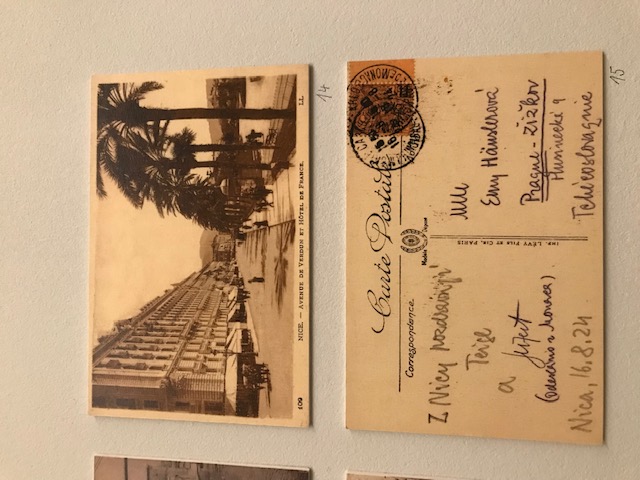
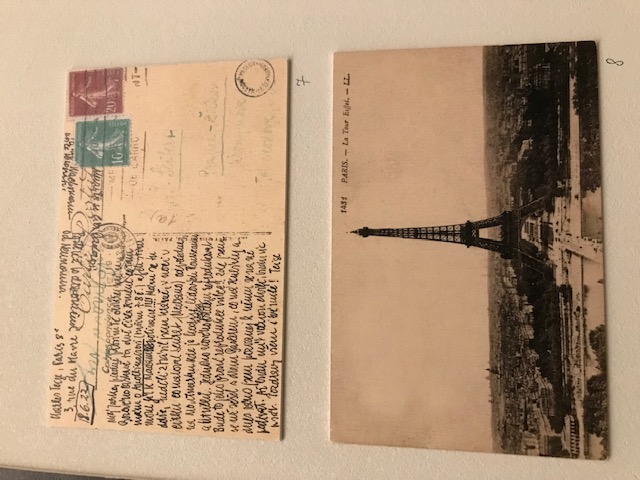
Postcards Teige sent to Prague also make up part of the exhibition and document his enthusiasm and impressions. I saw one side of a wide boulevard lined with palm trees on a postcard from Nice in 1924. Another, addressed to Seifert in 1922, shows the Eiffel Tower’s dominating presence.
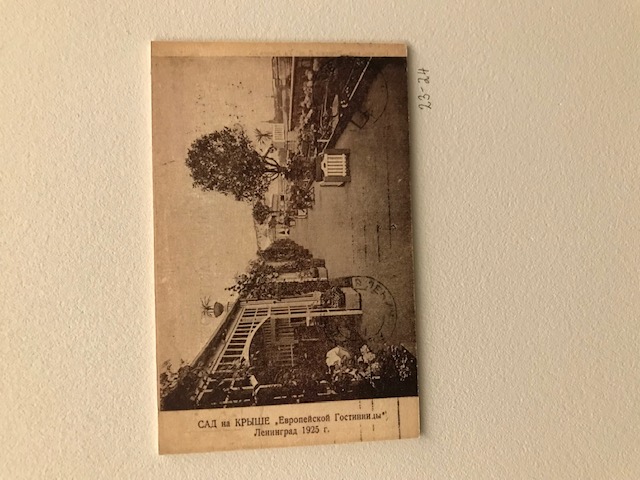
Teige’s 1925 visit to Russia is featured, too. This journey was key to his political and cultural development, and his relationship with Russia would remain significant for the remainder of his life. Teige’s first time in Russia strengthened his left-wing political beliefs. A postcard of Leningrad dates from November of 1925. A photo shows Teige walking onto a desolate Red Square. Another shows Teige standing in front of an art gallery in Moscow, a huge sign dominating the background.

While this exhibition focuses on Teige’s life through 1925, it also notes Teige’s difficulties during later years. Teige would promote Communism until the late 1930s, when he became dismayed with totalitarianism due to the Russian government’s oppression of modern artists.
After breaking with Communist ideology, Teige became an outsider in society. Still, his works influenced the Czech surrealism movement and served as an inspiration to young avant-garde artists. Teige died of a heart attack in October of 1951 during the horrific Stalinist era of Czechoslovakia. Certainly, his criticism of the Stalinist Russia of the 1930s caused him many hardships during the Stalinist regime of Czechoslovakia during the early 1950s.
Many of Teige’s book covers and illustrations are exhibited in the permanent exhibition, which poignantly covers 19th and 20th century developments in Czech literature with artwork, manuscripts, books, magazines, correspondence, photos, sculpture, artifacts and interactive displays. For those interested in the country’s literary developments, it is definitely a sight worth visiting.
Temporary Exhibition: Karel Teige Diaries 1912 – 1925, Small Gallery, May 17, 2023 – September 17, 2023
Museum of Czech Literature
Pelléova 44/22,
Praha 6 – Bubeneč
Opening hours: Tuesdays through Sundays 10 am to 6 pm
* * *

Tracy A. Burns is a writer who has lived in Prague for more than 25 years. She has written about travel for her blog Tracy