

Within walking distance of the train station in Nantes stands the Chateau des ducs de Bretagne, a 15th century castle built by Francois II, the last Duke of Brittany, and his daughter, Anne, who ruled twice as Queen of France (Charles VIII and Louis XII}. The chateau houses the Musee d’Histoire – 32 rooms covering eight centuries of Nantes history.
The Museum of the New World in La Rochelle is housed in the Hotel Fleuriau, a Parisian style mansion built between 1740-50, with rooms and salons furnished in the Louis XV and Louis XVI styles. The mansion was purchased in 1772 by Aime-Benjamin Fleuriau, who returned to La Rochelle after having made his fortune working on the family plantation in Saint Dominique. The Fleuriau family continued to live here until the mid-20th century.
These two museums presented France’s involvement in the Trans-Atlantic slave trade – a subject I was painfully unaware of. France ranked third in human exports behind Portugal and England. France went through Abolition twice – once in 1791-92, and again in 1848, after Napoleon Bonaparte had re-established slavery in the French colonies in 1802 at the behest of the merchants and ship owners in Nantes.
I visited both Nantes and La Rochelle, which were the top two French ports shipping slaves to the Americas and the French West Indies during the 16th-19th centuries. Nantes derived most of its wealth from the slave trade, which is still apparent in the Feydeau district, where ship owners built mansions with the fortunes they made from the slave trade and the import of New World commodities including indigo and cotton.
In the Musee d’Histoire in Nantes there were two garments dating to the 1790s. The gentlemen’s men’s suitcoat looked like it was made from a twill weave wool with embroidery, probably in silk floss, with matching breeches. The unadorned white waistcoat appeared to be silk.
The women’s gown is a dress à la française, or ‘sack dress.’ I don’t know much about this period, but I assume the nickname of ‘sack dress’ comes from the two box pleats on the back of this style of dress which adds a lot of fabric to the back. From what I gleaned from the V&A Museum, the full petticoats and hoops from the previous decade were replaced by smaller hip pads which added a lesser fullness to the skirt. I was struck by the center front lacing, and the absence of a stomacher – a triangular shaped and usually highly ornamented panel that would have been inserted behind the lacing and held in place with pins.
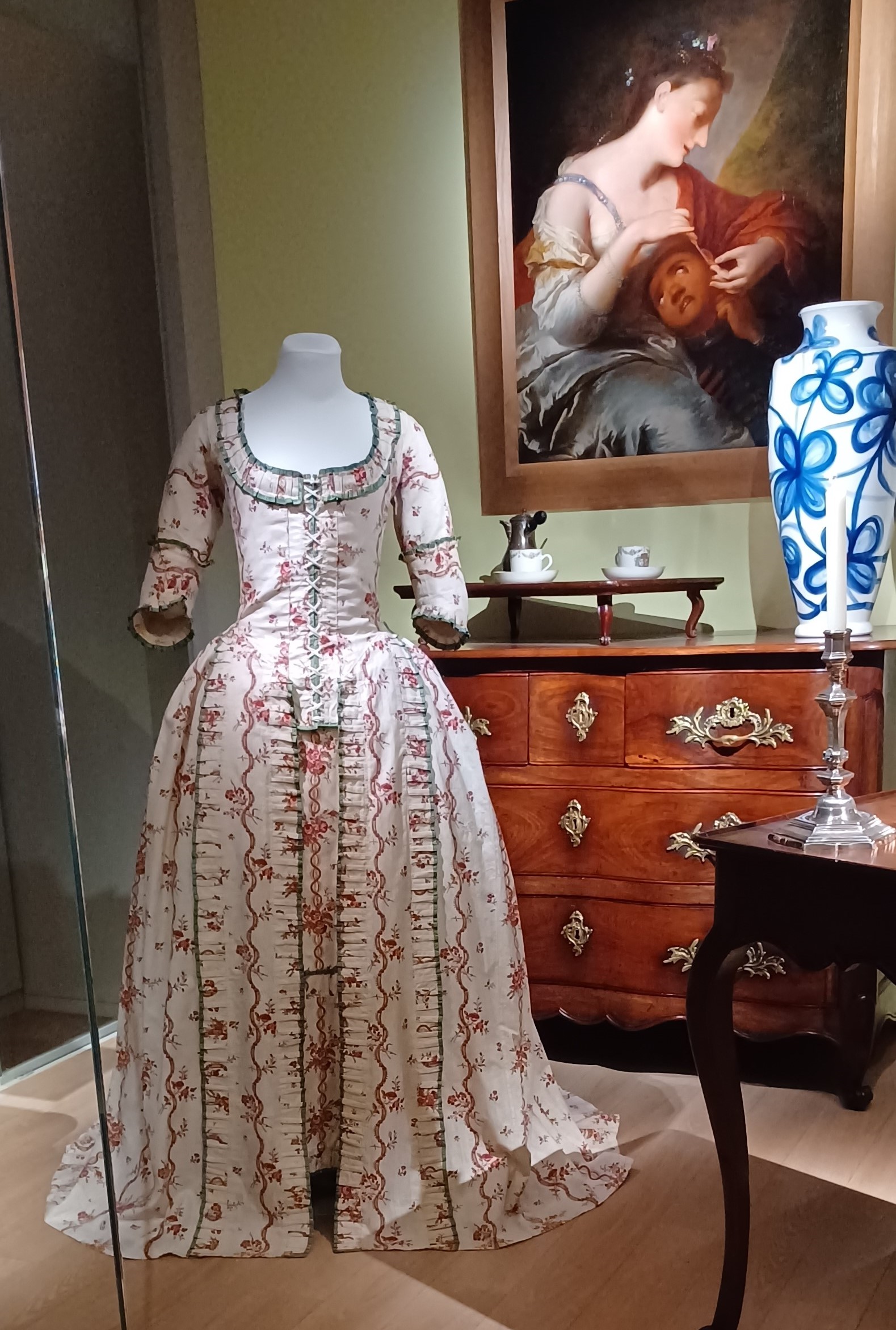
This dress appeared to be made from printed cotton, which had been forbidden in France between 1686 and 1759. According to the Metropolitan Museum of Art, printed cottons (chintz) were seen as a threat to the domestic silk weaving industry, so silk producers petitioned the government to ban them. Legislation was passed in 1686 prohibiting the importation and domestic production of printed textiles. For a more in-depth study on this topic, check out this BBC article: The Floral Fabric that was Banned
In spite of the ban on trade, merchants smuggled the highly sought-after “indiennes” into the European market under the flag of the East India Company. When the ban was lifted in 1759, textile printers in Nantes including Petitpierre Brothers, Gorgerat and Langevin produced up to 26,000 pieces a year over the next 20 years for both the domestic and African markets.
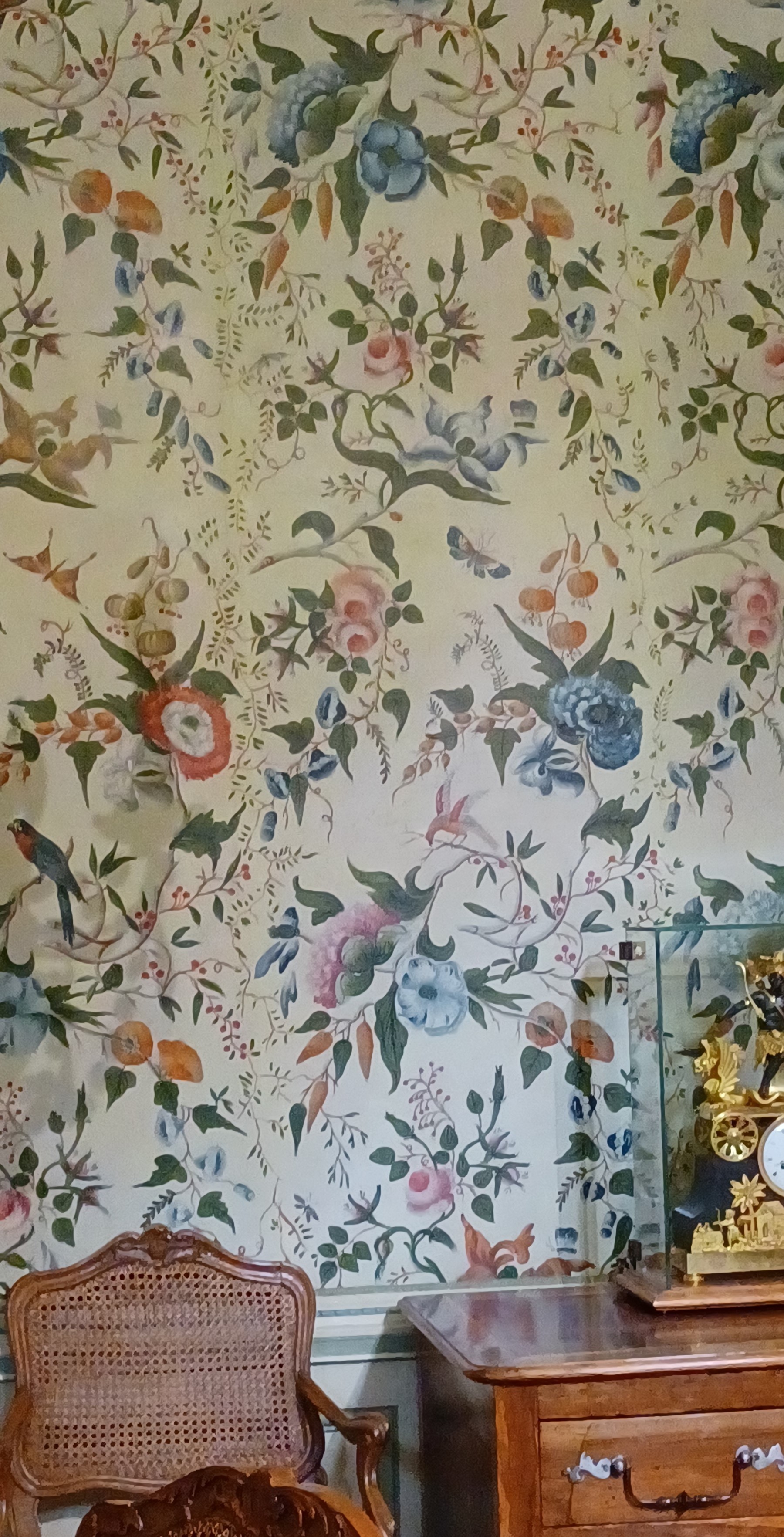
I would find floral wallpaper that imitated the printed fabrics that were forbidden in France, in a salon in the Museum of the New World in La Rochelle.
Fashion as it related to France’s trade routes also extended to the home, with coffee, tea and chocolate pots being designed both domestically and in Chinese factories to accommodate Europe’s new-found taste for those commodities from the Americas and West Indies. Here are a few of my favorite pieces from Nantes. The first, because I am a fan of Absinthe; the second because it showed the spices that were popular and where they were exported from, although apparently I was more interested in photographing the porcelains than the spice map…


This plate shows the merging of the arms of two important merchant families in Nantes – Pierre Antoine Espivent de La Villesboisnet and Elizabeth Genevieve de Montaudouin, who were married October 12, 1750. It is white porcelain painted with polychrome enamels, produced by the Compagnie des Indies Decor in China.

Visiting multiple museums in an area has often provided me with deeper insight into specific topics than a single museum might offer. I found that to be especially true of these two museums, whom when combined, provided me a better understanding of how trade affected home and wearable fashion, and how deeply fashion was tied to the political and economic world of 18th century France.
https://www.chateaunantes.fr/evenements/musee-dhistoire-de-nantes/
https://museedunouveaumonde.larochelle.fr/
https://augustphoenixhats.com/fashion-and-trade-in-18th-century-france/
* * *

Heather Daveno hails from Seattle, Washington. She is newly retired and divides her days in between three 501c3 organizations, where she is currently writing grants, managing social media, running a makerspace and making hats and clothing for a living history museum called Camlann Medieval Village. She is also writing a family history (The Matriarch Diaries) as well as a retrospective of her gig as a hatmaker (The Storied Hat). You can see her current textile projects at August Phoenix Mercantile and her travels at Daveno Travels.