
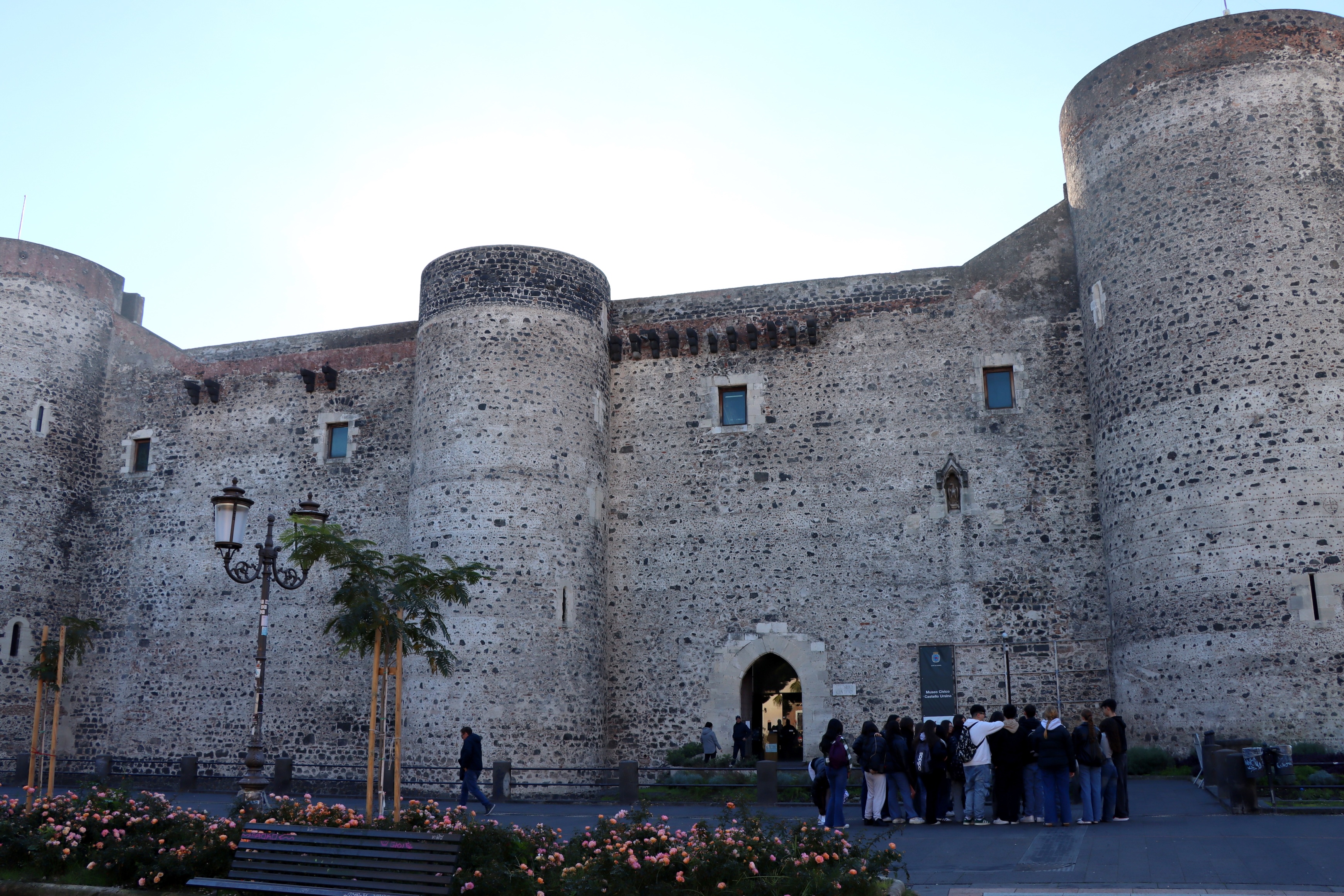
Believe it or not, this 13th-century castle once stood as a sentry, guarding the city of Catania, Sicily, from the top of a seafront cliff. When the eruption of Mt. Etna occurred in 1669, it reclaimed the entire area to the south, changing the landscape, and the Castello Ursino was suddenly landlocked. Since the castle had ramparts and moats, diverting the lava away from the property and back towards the sea, the foreboding structure was spared.
My friends and I arrived early, before the museum had opened. It was a delightful and impressive sight, with a courtyard and garden in front. I loved the black and gray stone patterns instead of dirt under my feet and the fact that we were admiring rose bushes in full bloom – even though it was the start of January and winter, was a real treat! There was a group of students on a field trip wandering around, talking about what we might find inside once the massive doors opened.

The Ursino Castle is home to the Civic Museum. It boasts two priceless collections: the Benedictine collection is located here at Ursino, and the second is located in the nearby Biscari Museum, along with other works that belonged to private individuals. Because the museum has a large number of works, it’s been separated into sections covering archaeology, medieval, Renaissance, and modern periods. We were happy to see that they also have a dedicated section honoring talented artists from Catania. Besides these permanent exhibitions, the castle hosts temporary exhibitions and several events throughout the year. In fact, one of the rooms we walked through during our visit was set up for a Christmas concert that evening – we could only imagine the acoustics in the cavernous room!
Once we were allowed in, we moved to the head of the line quickly. We listened to a woman at the front desk as she explained a few interesting facts about the castle, and then we were off to explore the rooms and floors of this beautiful fortress on our own. It was a little overwhelming with so much to see, and it was hard to know where to start! We decided to turn away from the crowd and head to the right.
We entered a room with high, skinny windows where natural light streamed in. We learned that they also allowed for ventilation and gave clear views of any attackers below who might be surrounding the castle. The slim windows were excellent places for archers and crossbowmen to position themselves in defense of the Ursino. Because the hiding places were so high, we did wonder how the men might have made their way up there – it was a hmmmmm moment, for sure. I mean, did they have ladders? Maybe they stood on each other’s shoulders? We grinned at each other as we contemplated the possibilities and made a note to find out later.
Looking straight up, we saw what is often referred to as a ‘ribbed vault.’ These were renowned for their structural soundness in medieval times, enabling the construction of larger and more spacious rooms in places such as castles, cathedrals, and churches.

In one room, which showcased a large bronze sarcophagus, we spotted a stunning gold-leafed triptych depicting the Annunciation scene of the Holy Mary with the child, St. Lucy and St. John. The person who created this beauty is an unknown Sicilian painter from the early 15th century. It’s not often I get to stand in a room with priceless pieces this old. I was very moved looking around inside each chamber.


We stood in front of an Ancient Roman mosaic which represented an allegory of Africa. It dated back to the 1st century AD. It was surreal, seeing something that ancient in person!
During part of our visit, we were treated to a very unique experience. Italian students studying art came and asked in halting English if they could critique a few of the paintings to practice their language skills. I was asked to select a painting that interested me. I stood quietly while the art/language student tried to explain the artist, technique, and meaning. The same happened with my friends, and we were very impressed with this immersive way of learning. There should be more of it in other countries, for sure.
The students were led by their professor, and if they had a question they were unsure of, they didn’t hesitate to approach the teacher for help. They were curious about where we were from, why we were at the museum, and whether we would ever come back – in other words, they wanted to know if we thought it was worth the trip to visit, smiling when we said we would love to return and learn more about the castle, its history and collections.

Peeking over a railing in one room, we looked down and were astounded to see an open area where famed artwork was being painstakingly restored. I can’t imagine how challenging, yet rewarding, that work must be!


No matter which way we turned, there were artifacts, headless statues, engravings, artwork in the process of being restored, incredible views from windows on the second floor, drawings of the area before the devastating eruption of Mt. Etna so many centuries before, to name only a few. We spent a few hours here before our next appointment, but wished we could have enjoyed even more time wandering around.


It was fun to learn a few things about the castle. It was built in the 13th century by the Holy Roman Emperor Frederick II as a defensive stronghold for the Kingdom of Sicily and was a symbol of royal Swabian power. Later, in 1397, Frederick III’s daughter Maria was kidnapped from the castle by Guglielmo Raimondo Moncada. He was the Count of Augusta and did not want her to marry another man. She was rescued and eventually married her cousin Martin – who was also her uncle! It was even used as a prison for a time, and some evidence of that remains within the walls of Ursino. And, because I love ghosts, the most fun subject for me to learn about would be the rumors of apparitions, mostly stories shared by those who work inside the building. Too bad I didn’t see any!
Hours: Monday – Saturday, 9:00 am to 7 pm, and Sunday from 9:00 am to 1:30 pm
Address: P.za Federico di Svevia, 21, 95121 Catania CT, Italy
Cost: 6 euros
Telephone: +39 095 742 1111
I always feel incredibly blessed when I have a few free hours to visit a museum. They can teach us so much about the history and culture of the area – I always come away learning something new, especially when it's a venue in another country. It’s summer now, and I plan to look into visiting museums I’ve never been to before in the nearby towns and states where I live. Life sure is busy, but I hope you can find some time to do the same.
* * *

Theresa St. John is a freelance travel writer, photographer, and videographer based in Saratoga Springs, New York. She is interested in WWII history, museums, food, slavery, the Underground Railroad, interviewing interesting people, restaurant reviews, local travel, anything ghost-related, and the Erie Canal, among other things. Theresa loves to travel and sinks her feet into the moments of places she visits. Her photography essays, along with the written word, help tell the story to readers everywhere.