
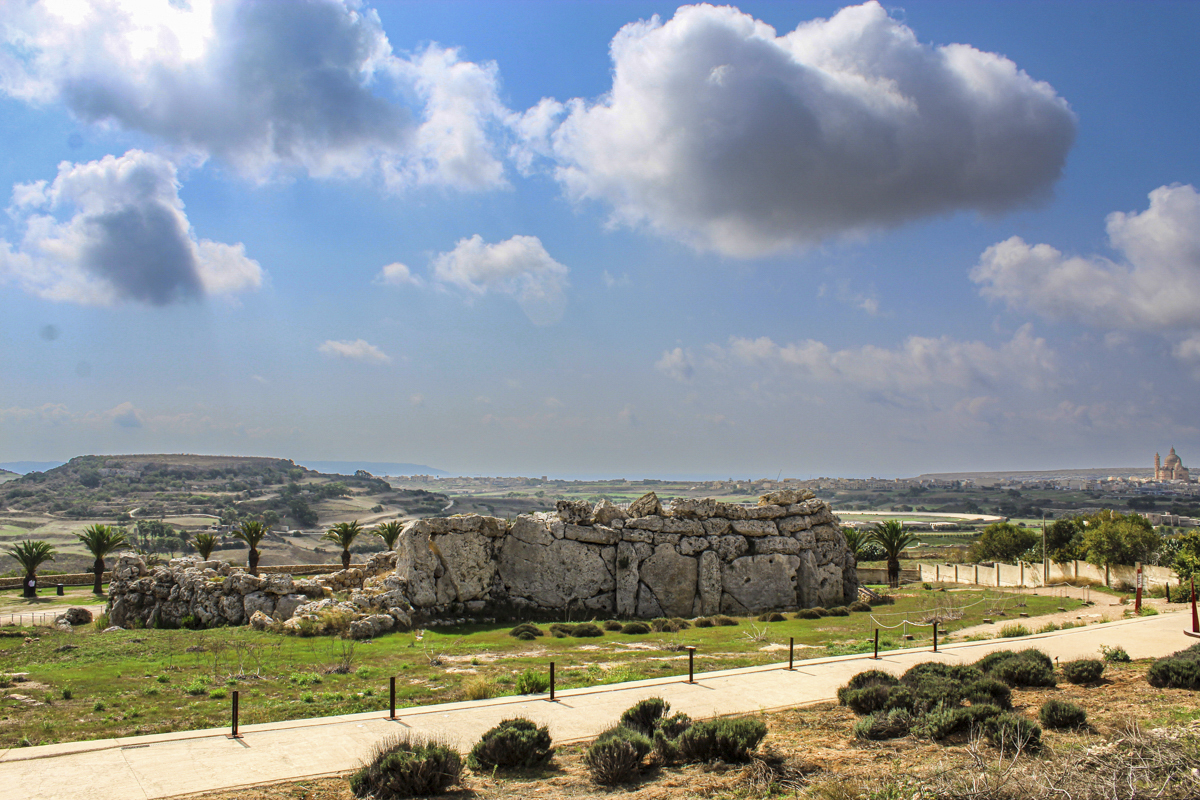
Who were the temple builders? How did they build the temples? Where did the people go? The answers to these questions remain a mystery. Folklore and science combine in the Ggantija museum to offer answers.
Ggantija Museum and Archaeological Park, a UNESCO World Heritage site estimated to be more than 5,500 years old, has long been an open-air museum of mystery, folklore, and archaeological wonder. It is located on the island of Gozo in Malta. Although the temple site was known to islanders for centuries, it was not excavated until 1827 by Malta’s Lieutenant Governor, Colonel John Otto.
When first entering the museum, we were struck by how easily we could see each panel and artifact without feeling overcrowded. The first exhibit shows how archaeologists and scientists have determined that Neolithic people chiseled the limestone with obsidian, a volcanic glass.
It appears they moved these enormous stones into place using round rocks. This was done before the wheel and metals were invented as tools. Archaeologists discovered round stones believed to have been used to roll massive slabs located three kilometers away.

Not all ancient temples were used for religious beliefs; many were used for rituals. It is thought that the Ggantija Temples were used for fertility rites. The information from the panels and visuals gives the visitor an insight into the temples’ uses.
Fascinating figurines found at the site led investigators to their conclusions. Carved figures of large-hipped women suggest the Goddess of Fertility. Scientists have determined that an Earth Mother Goddess cult existed on the islands. These carvings have been discovered at many of the historic sites on Gozo and Malta.

Pottery is on display, showing not only the skill of these ancients but also the practicality of the vessels used for cooking and drinking. Our favorite item is a strainer made from hardened clay. Experts agree that this is a miraculous, rare find, as few have ever been recovered from the Neolithic age. It may have been used for ceremonial purposes.
Beautiful jewelry made from bone and shells gives a glimpse of these people’s artistic nature. The second exhibition room also has necklaces made from bone and beautiful green stones. In the same display, two carved stone heads join jewelry.

A descriptive panel shows the diet of these temple builders. Surprisingly, it is very similar to our diet today. A tremendous mortar, used for grinding grains and other foods of this era, takes up a corner in the first exhibit room.

Judging from the section on hair and dress, they were stylish people. Most carvings and depictions show short, pleated skirts similar to those of Roman soldiers. After 5000 years, no traces of fabric remain, but we think you will see the similarities. The carvings show men’s hair in similar styles. One of the exhibits reminded us of the ‘powdered wig’ era in 18th and 19th-century Europe.
Flint, chert, and obsidian are among the artifacts and tools used to chisel stone. Animal and fish bones were most likely used for sewing.

Adding to the mystery of Ggantija, two stone heads depicting males were found during the excavation in 1827. Along with the heads were figurines of men’s heads. The meaning of these finds has yet to be determined.

One of the most precious finds was an intact human skull. This display fascinated us. Using today’s technology, forensic experts determined it to be a female. The scientists were able to recreate what this young woman looked like.

An excellent video shows the two temples and other temples on Gozo and Malta. The detailed video explains the history of Ggantija. They were known to the native islanders and explorers. The film takes you through the discovery, the mistakes, and what is being done to preserve this historic treasure. We highly recommend taking a few minutes to watch this film.

Locals and some travelers knew of the site and had passed down stories about its interminability. Village folklore on the island had long believed all the temples were the work of giants that once roamed Gozo and Malta. Ggantija, meaning giant, was thought to be built by the giantess Sasuna, a giant woman who had had a baby with a Maltese man. She was a giant of extraordinary strength. She built the temples, with some stones weighing 50 tons, while carrying her baby and subsisting on broad beans and honey.
Older than Stonehenge or the Pyramids, Ggantija is the second-oldest standing temple structure in the world. Although there is no evidence of any written language or drawings, the temples’ architects communicated the construction and astrological alignment of these structures with astonishing precision. The cloverleaf design of the two temples demonstrates precise building techniques from a time long before modern humans recognized their capabilities.

The stone for the structures was sourced nearby. Limestone is abundant on the island, and two different types of stone were used. The exterior and room-dividing walls are made of coraline limestone. Coraline is a tough rock. It has been used on Malta and Gozo for centuries to construct homes and apartments. Globigerina limestone was used for altars, doorways, and decorative stonework because it is softer, allowing it to be shaped more easily.
The Ggantija temples were known much earlier in the 18th century from highly accurate drawings by John-Pierre Houel. In 1827, Lt. Governor Colonel John Otto cleared the area around the temples, making them more visible. Sadly, many artifacts were lost during the process due to a lack of knowledge of archaeological practices. Reproductions of pictures painted by Charles Frederick de Brocktorff seven years before Colonel Bayer’s excavation show the magnificence of these two temples.

Raised walkways allow visitors to view the ruins safely while protecting these ancient gems from further damage and wear. Although the Ggantija Temples seem small by today’s standards, they were massive to a civilization of people who averaged less than five feet tall.
Evidence of fire being used for sacrifice on the altars coincides with animal bones found in the ruins. The sacrificial altar still shows the signs of the fires below. You will see vessels in the ground believed to hold liquids involved in the rituals.
Some outer rooms have rings of stone in the ground, which are thought to have been used for fire and warmth during the rituals. Archaeologists have found evidence that the buildings were roofed, and the insides were once coated with a red ochre stain. The stain is still visible on some of the limestone.

Many of the slabs have perfectly round holes that are still a mystery. Some experts think they were used for pulling and placing the stones with ropes; others argue that the holes are too perfect to have been used for those purposes. Sadly, graffiti was left by a few individuals dating from 1821. Thank goodness this practice is forbidden at the site now.
Open seven days a week, 10 am to 6 pm.
MTA buses 322 and 307 drop off in front of the museum.
Free parking is on the street.
Admission is zero to $12.00.
Another way to see Ggantija is with a Heritage Malta Membership. The membership card allows you free entrance to over 300 museums and ancient sites on Malta, Gozo, and Comino islands.

Ggantija, located on Gozo, Malta, is a UNESCO World Heritage site and one of the world’s oldest temple complexes, dating back over 5,500 years. Known for its gigantic limestone structures, it reflects advanced Neolithic engineering. It is steeped in local folklore, including legends of giants involved in its construction.
We may never know the precise history of the Gozitan and Maltese Neolithic societies that disappeared in 2500 B.C. Now, we have evidence that they were highly advanced compared to what we once thought. The Ggantija Museum and Archaeological Park give an insight into a lost civilization thousands of years ago.
* * *

Mary and Kevin are travel writers, travel photographers, and hotel scouts. They are based in Gozo, Malta. M&K travel internationally and domestically, looking for their next travel story.
Mary and Kevin are lifelong photographers and passionate travelers. Mary became a published travel writer in 2016, and Kevin began his career as a travel journalist in 2021. Today they work together, focusing on off-the-beaten-path, not-well-known, and in-the-shadow-of locations. They delve into art, music, food, and libations. In addition, they explore architecture, museums, parks, well-curated tours, history, agriculture, and the unexpected in micro-towns and big cities, domestically and internationally.