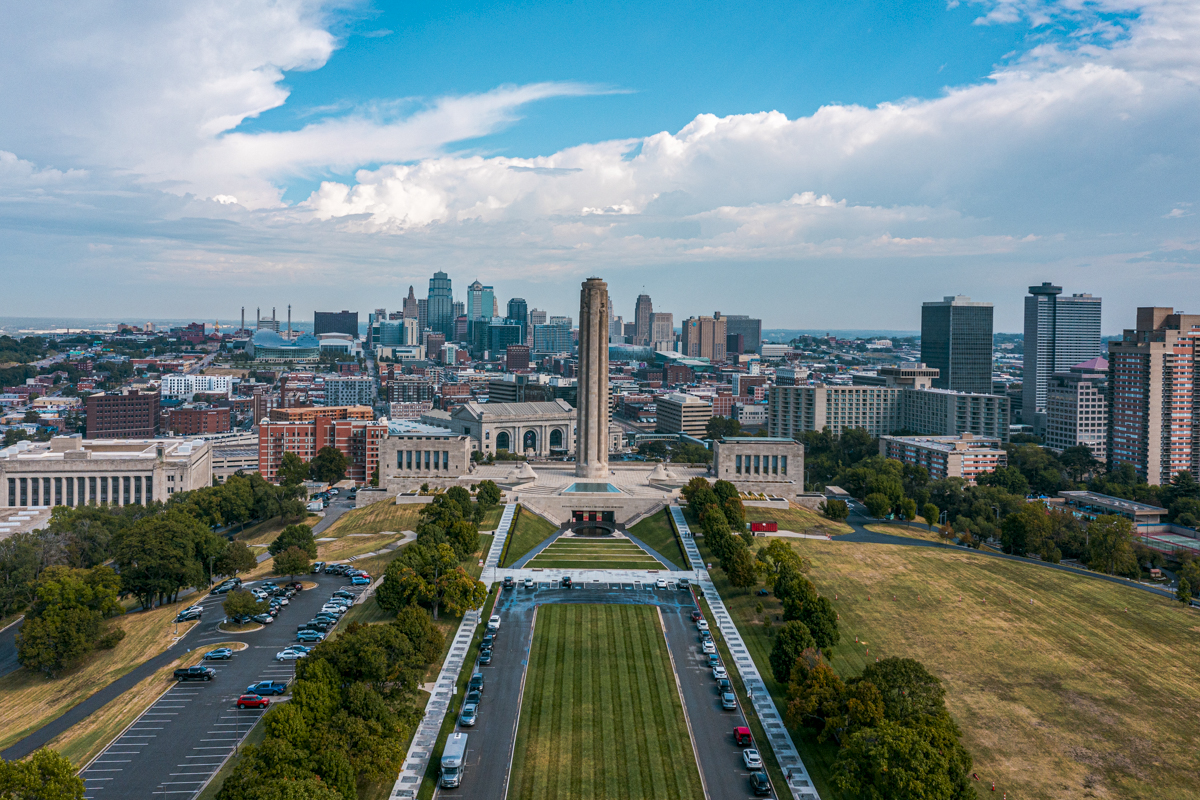
Above: The National WWI Museum and Memorial in Kansas City, MO. ©Aaron Fuhrman
As you drive down the long avenue leading to the spectacular monument’s tower, flanked by two enormous Assyrian sphinxes, you are struck not only by its size but also by the beauty of what it represents. This is truly a fitting monument to the men and women of that time in history, who gave their lives in the hopes of world peace.
When we visited Kansas City, Missouri, we were excited to visit The National WWI Museum and Memorial. This was our first chance to see this beautifully restored monument. It was the first time Kevin had visited the memorial since grade school, when he attended a commemorative speech by President Dwight D. Eisenhower.
After WWI, leaders and citizens raised over 2.5 million dollars to erect a monument to the men and women who gave their lives in the Great War. Europe and America were dramatically changed after that sad period in human history.
Construction of the memorial began in 1920. In 1921, it was dedicated by the 5 Allied commanders, who met in person for the first time. The event was attended by over 100,000 enthusiastic citizens in front of the 217-foot limestone shaft.
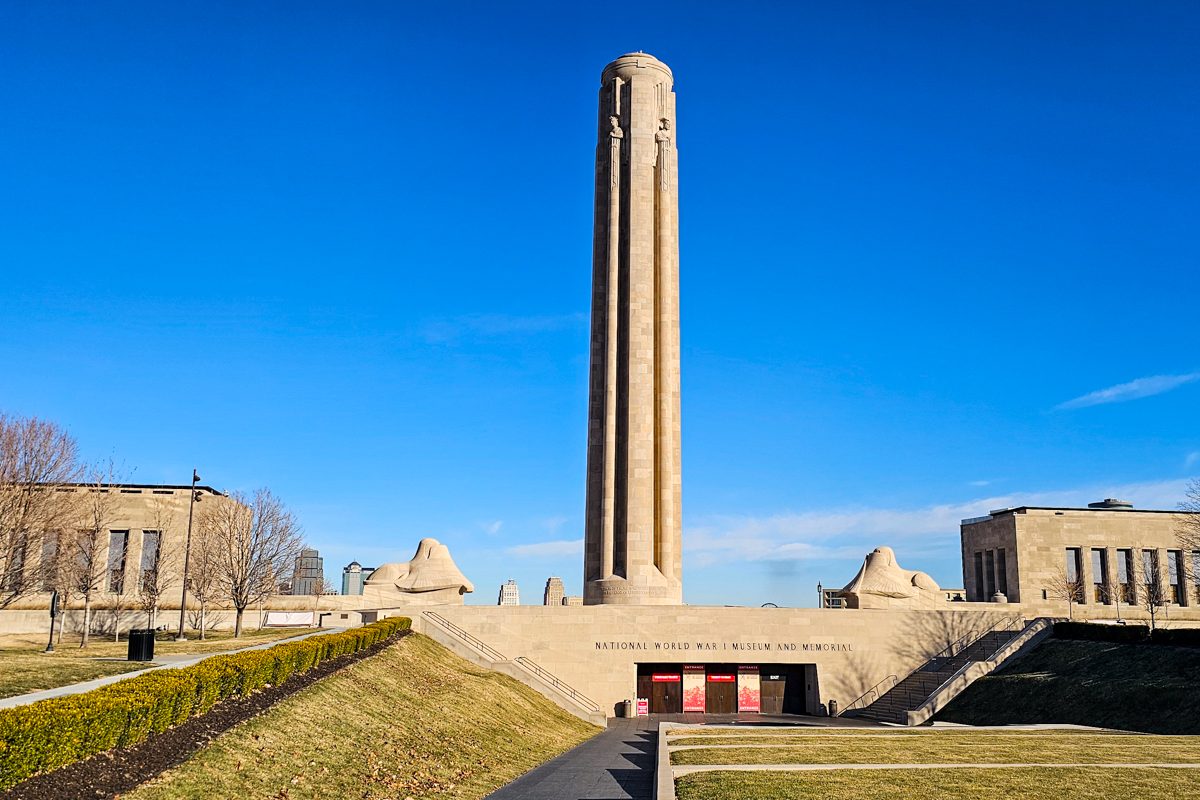
The tower was flanked by two Egyptian Revival Sphinxes, and two exhibit halls on the east and west sides of the memorial tower. The tower has four carved guardians symbolizing Courage, Honor, Patriotism, and Sacrifice. The Sphinxes face east and west. Their eyes are covered by their wings. The one facing east, towards Europe, is protecting its eyes from the horrors of war, death, and destruction, while the Sphinx facing west shields its eyes from the unknown future. The ongoing works were completed in 1926, and the Liberty Memorial was dedicated by President Calvin Coolidge.
Sadly, the underfunded memorial descended into extreme disrepair. Because it was considered a public danger, it was closed in 1994.
1998: Kansas City political and business leaders rallied citizens to once again raise $102 million to restore and expand this precious monument.
2004: Congress renames Liberty Memorial to America’s official WWI Museum, and construction begins on an 80,000 square foot innovative museum underneath the shaft and Sphinxes.
2006: The Memorial is designated as a National Historic Landmark.
2014: Congress designates and identifies it as the National WWI Museum and Memorial.
From the outside, you are unaware of the museum’s enormity beneath the memorials. This structure houses over 350,000 artifacts and documents in a massive 32,000-square-foot space. You will be captivated by a glass floor showcasing displays, immersive battle scene dioramas, and exhibits highlighting America’s involvement, offering a poignant and educational journey through history.
The first eye-catching exhibit is the glass floor above a field of 9,000 poppies. The field represents a No Man’s Land (NML)with each poppy representing 1000 soldiers who died in this terrible war. These NML were anywhere from 50 yards to a mile apart. Some were as close as 33 feet from each other.
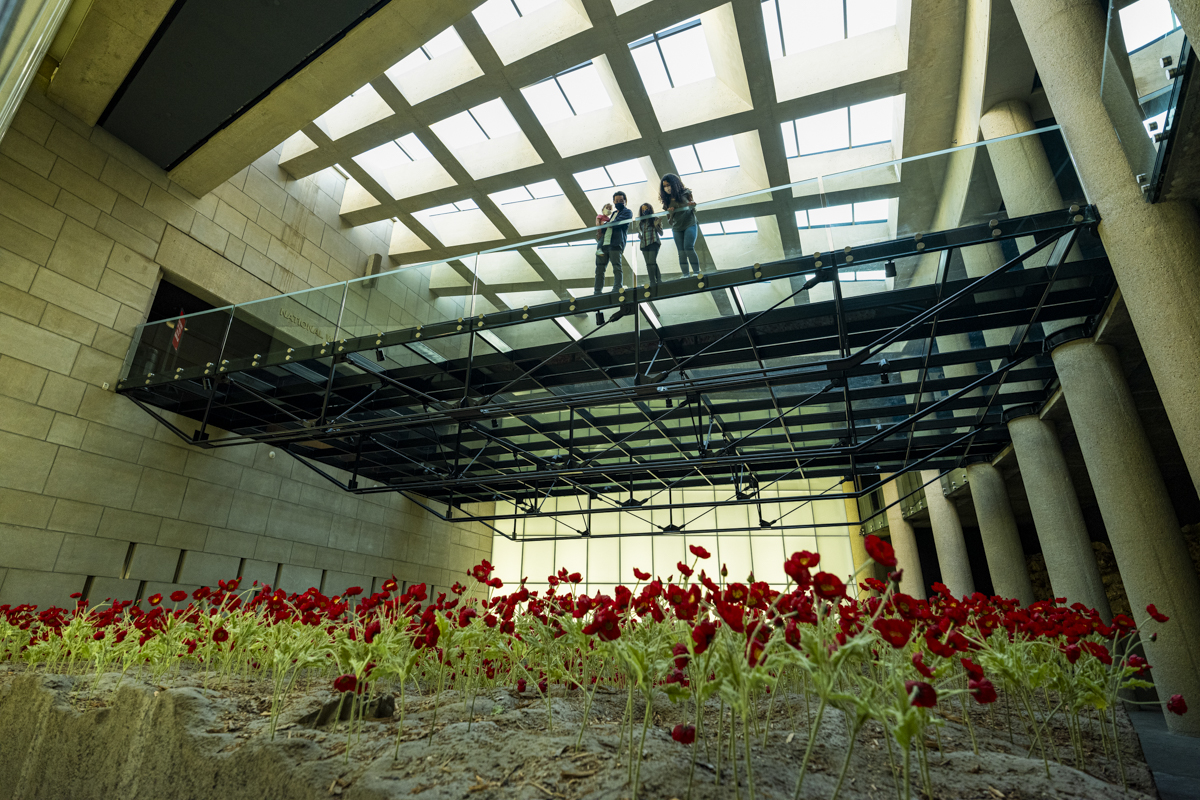
Once you cross the NML, you are encouraged to watch a film in Kemper Horizons Theater about the events leading up to the start of The Great War and the United States’ entry into it in 1917. The film is a montage of footage from around Europe and America. We found it explained events we were not aware of.
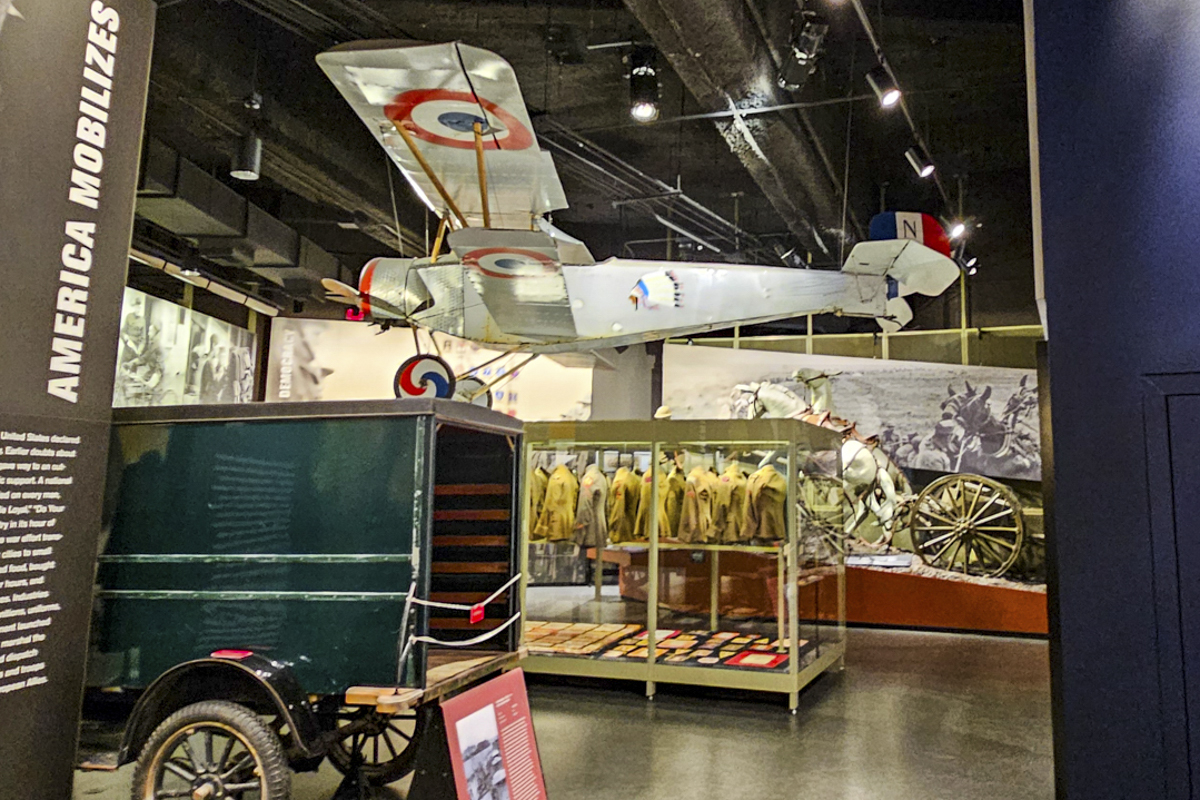
We moved from the theater to a small part of their tremendous armory, featuring weapons, uniforms, and even WWI planes. Some of the artillery pieces were so big that they made the planes look small. Wandering around the vast displays of weaponry, we marveled at the array of weapons used by the various nations involved in this war, frightening as they were.
There is a telling exhibit of how America was drawn into the war. This was the first time we had learned of the tremendous impact women had in the First World War. They entered the armed services as yeomen and Signal Corps operators. Many either were or became nurses.
Men and women needed support before, during, and after their duty. Before the USO was formed in 1941, many women volunteered for the Salvation Army, the YMCA, and several other organizations, providing food, recreation, and social support. We found the information on signage and interpretive panels added to the experience as you make your way through this labyrinth of history.
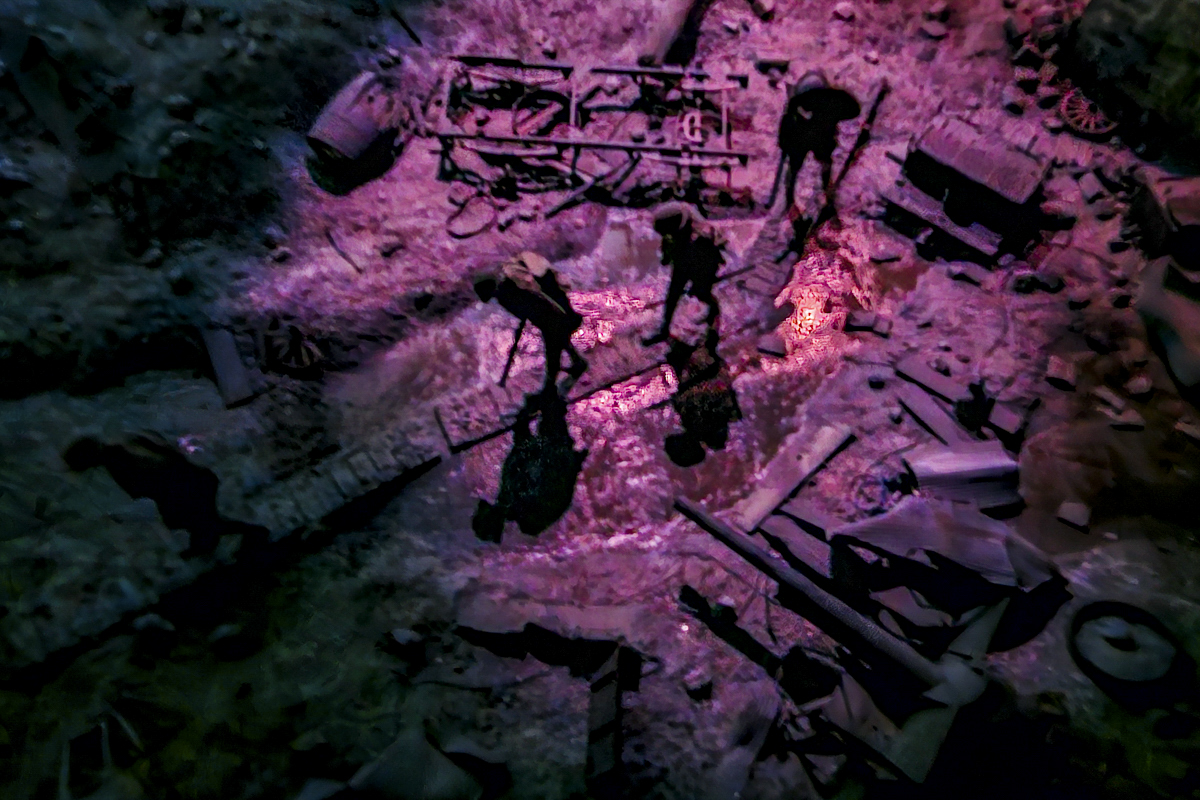
As you move through the museum, you will come across life-size dioramas that take you to the battlefield. The first striking one is a defeated-looking group of soldiers walking on wooden boards to avoid getting stuck in the mud. One of the many interpretive panels discusses the deadly mud. Trenches would start to fill with rainwater, and mud walls would collapse on the men. It was heart-wrenching to look at the diorama and imagine the young men trapped beneath the mud.
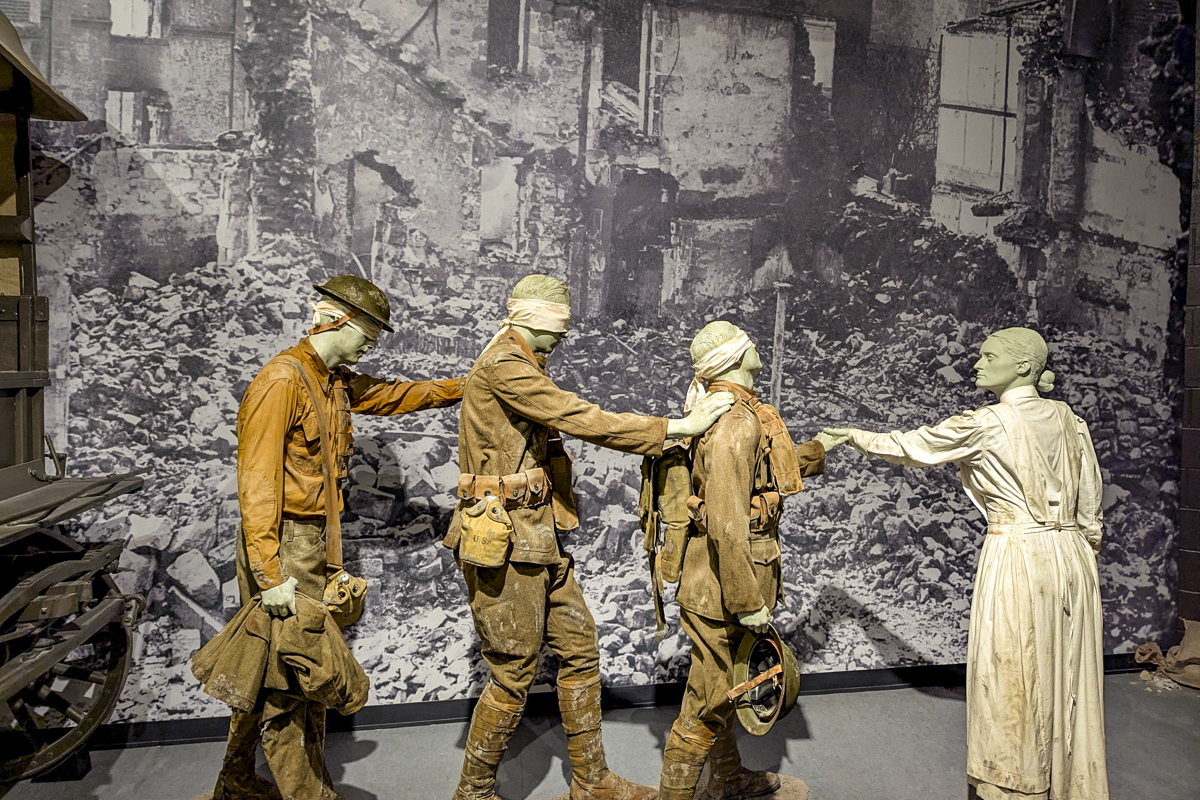
There are five life-size dioramas depicting life, horror, and sadness that the Great War created. Each of these tells its own story, for example: injuries causing blindness, a soldier’s fear and panic while being bombed, and servicemen doing their best to fight back, and several more. It truly brings the war to you in all its sadness.
The Artifacts section of the museum features a fantastic collection of uniforms worn by many of the countries involved. The rare weaponry in this section is fascinating. The different designs and intended uses make you realize how brutal this war was. Occupying most of a room is the first rotating turret tank. The French FT-17 tank was developed by Renault Automotive.
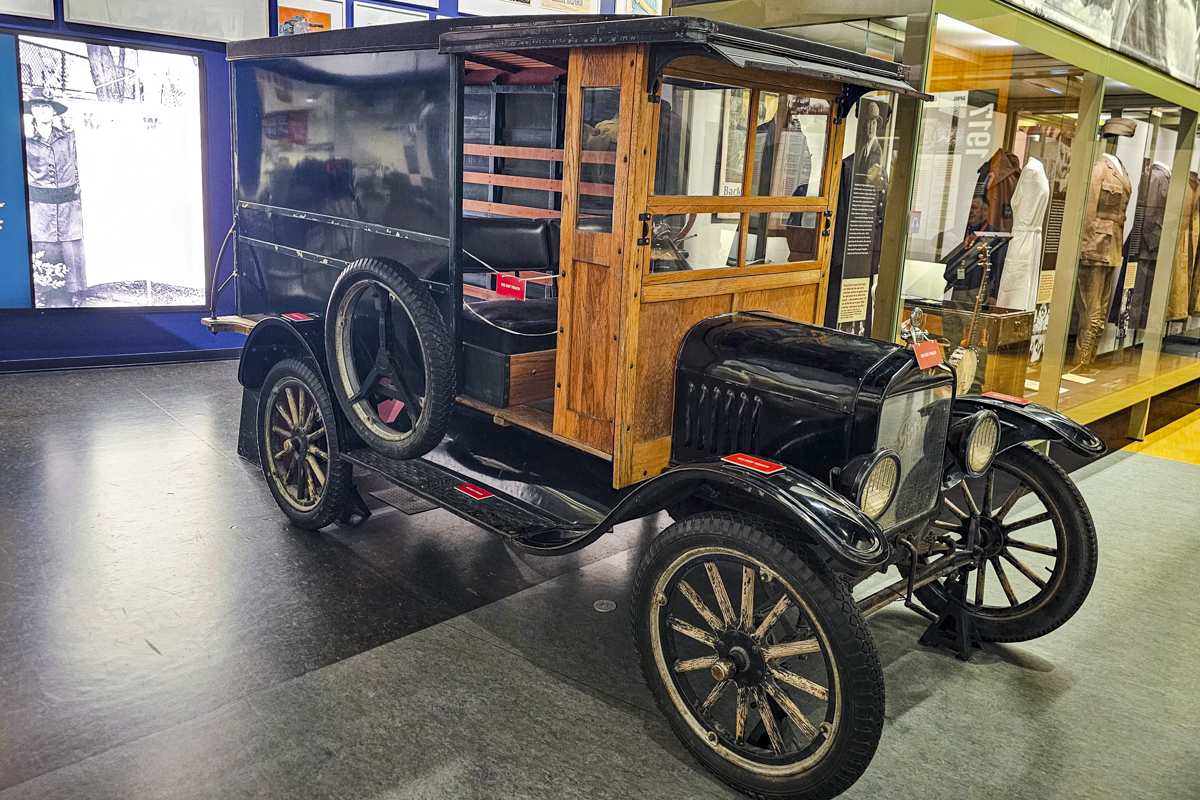
Your trip through the museum will take you to recreated battle scenes, including a bomb crater you can get into, creating the sensation of being in the midst of an actual attack.
There is a recreation of a French house, partially bombed out, and the devastation of war. The scenes, designed with the actual clothing and equipment used, made us feel as though we had a small peek into the intensity and frantic pace of the war.
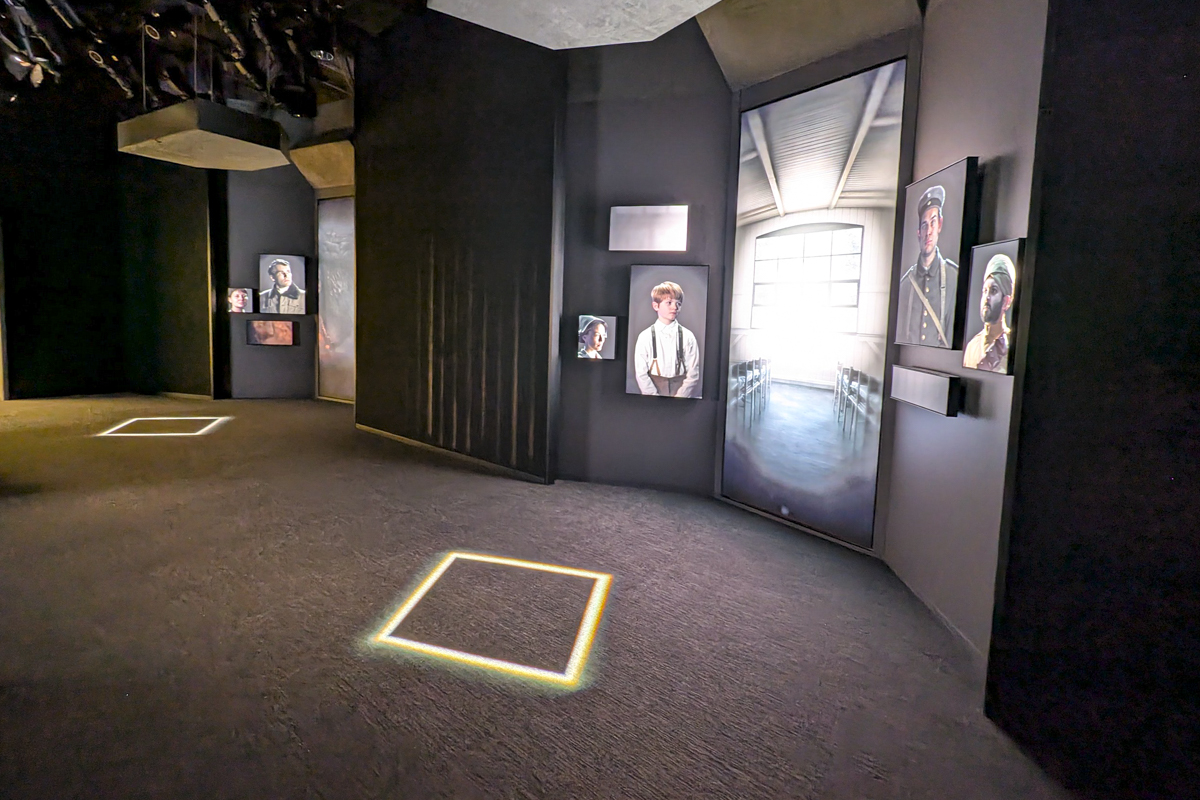
One of the most dramatic exhibits at the WWI National Museum is the Encounters exhibit. Part of this display features actual stories from 16 individuals caught up in the Great War. Using technology similar to the Sphere in Las Vegas, this exhibit and the Horizons Theater use Christie projection to recreate horrific trench warfare and battlefields, and to present personal stories drawn from diaries, accounts, and the faces of the 16 individuals who speak directly to you. This technology, combined with Pixera media services and the Isaac workflow platform, offers the closest thing to sitting down with someone and listening to their personal story. It is simply amazing.
Be sure to get your pass to ride up to the top of the tower. The views offer a stunning 360-degree view of Downtown Kansas City, Missouri, and Kansas City, Kansas, to the Northwest, and Greater Kansas City. Below you, to the south, are the rolling hills of Penn Valley Parks, 130 acres. Once you have come down, on the east and west of the tower are the Memory Hall and Exhibit Hall. They date back to the memorial’s original construction. Memory Hall is dedicated to the 441 Kansas Citians who lost their lives in this tragic war. Surrounding the walls are twenty-two flags from the nations involved in the Great War. Exhibit Hall, the original artifact museum, which Kevin visited as a child in grade school, is now a dedicated gallery space.
The summer of 2026 will feature two displays. The first will be the connection of European football to the war, and the second will be Paris at War. The Parisian exhibit will go into depth on the changes and impact the war had during and after that era.
We can’t tell all there is to see and learn at the WWI National Museum and Memorial. Still, we encourage you to visit this National Treasure. Only 5% of the museum’s 350,000 artifacts are on display, and we still didn’t take it all in.
The spectacular parks surrounding the memorial are ideal for picnics. We suggest making a day of it. Often, there is live music and fairs on the grounds. In the summer of 2026, it will host the FIFA World Cup Fan Festival.
The National WWI Museum and Memorial offers profound historical insight, honors sacrifices, showcases artifacts, and fosters remembrance. Make it your top destination when visiting Kansas City.
* * *

Mary and Kevin are travel writers, travel photographers, and hotel scouts. They are based in Gozo, Malta. M&K travel internationally and domestically, looking for their next travel story.
Mary and Kevin are lifelong photographers and passionate travelers. Mary became a published travel writer in 2016, and Kevin began his career as a travel journalist in 2021. Today they work together, focusing on off-the-beaten-path, not-well-known, and in-the-shadow-of locations. They delve into art, music, food, and libations. In addition, they explore architecture, museums, parks, well-curated tours, history, agriculture, and the unexpected in micro-towns and big cities, domestically and internationally.