I’ve always been drawn to the immediacy of live performance and the strange bargain it makes with time. A play, a concert, a dance, even a bad poetry reading in a room with folding chairs: all of them exist most completely, and in some ways only, while they are happening. You can record them, describe them, return to the same venue, sit in the same seat, and try to convince yourself you’re having the same experience again. You aren’t. If you’re lucky, the second experience may be better, deeper, more informed, but it won’t be the same as the first one. What you saw, heard, and felt will never exist again in exactly the same way at any point in human history.
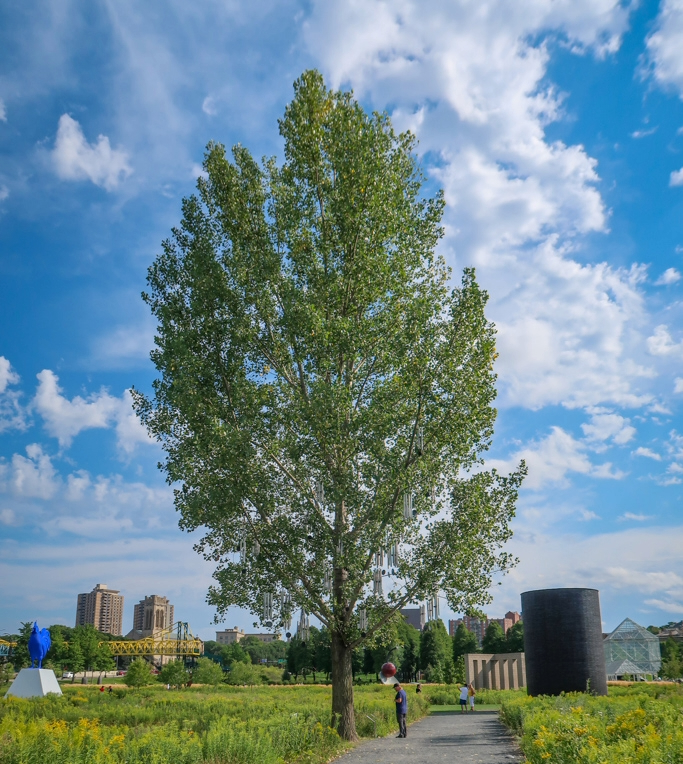
That was what I kept thinking about when I stood under Pierre Huyghe’s Wind Chime (after “Dream”) at the Minneapolis Sculpture Garden.
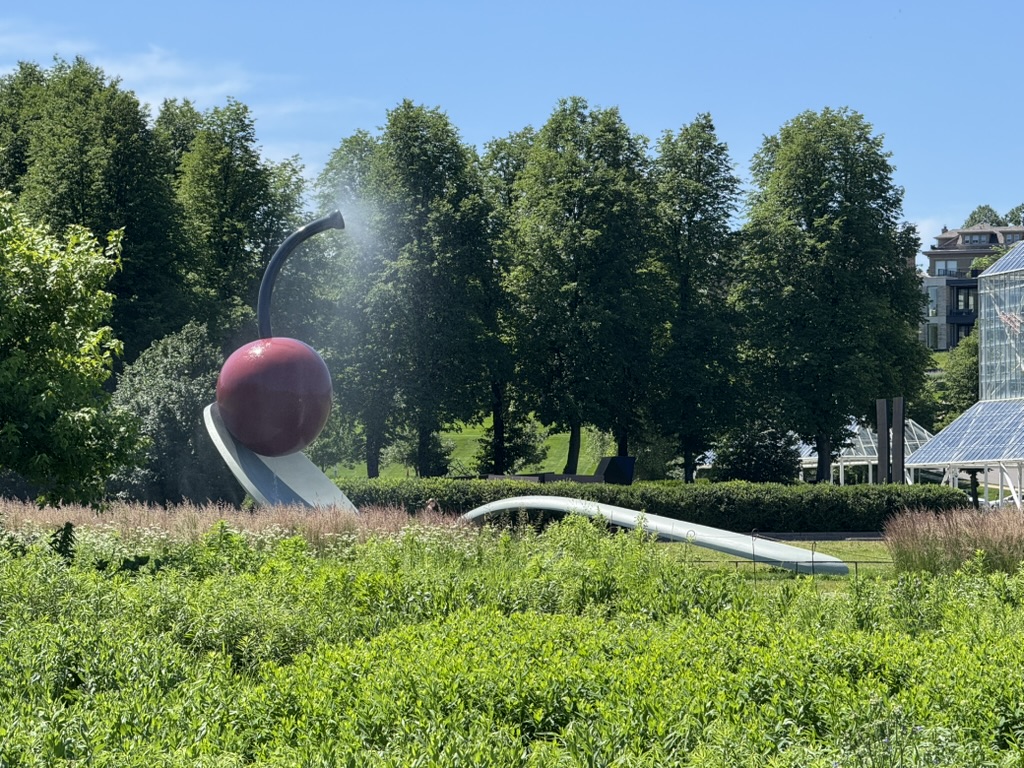
This is not the sculpture in the garden that most visitors come to see. That honor probably belongs to Claes Oldenburg and Coosje van Bruggen’s Spoonbridge and Cherry, which is so fully Minneapolis by now that it feels like a civic mascot. I understand the affection for it. It’s playful, public, photogenic, and instantly legible. You can love it in one glance. There’s a lot to appreciate about that. Accessible work often gives people their first reason to look more closely, and I would never want to discourage it.
Huyghe’s piece is something else entirely. I walked past it at first, either not noticing or not realizing that it was anything more than a tree growing in the sculpture garden.
The chimes are easy to miss, which is part of what I liked. In a garden famous for big gestures, Huyghe’s piece waits in the branches. You find it by looking up, or by hearing something before you understand where it’s coming from. It hangs there quietly until the air moves. Then a few notes, a shimmer, a small rearrangement of the space above you. No one starts it. The wind passes through, and for as long as it does, the sculpture becomes an event.
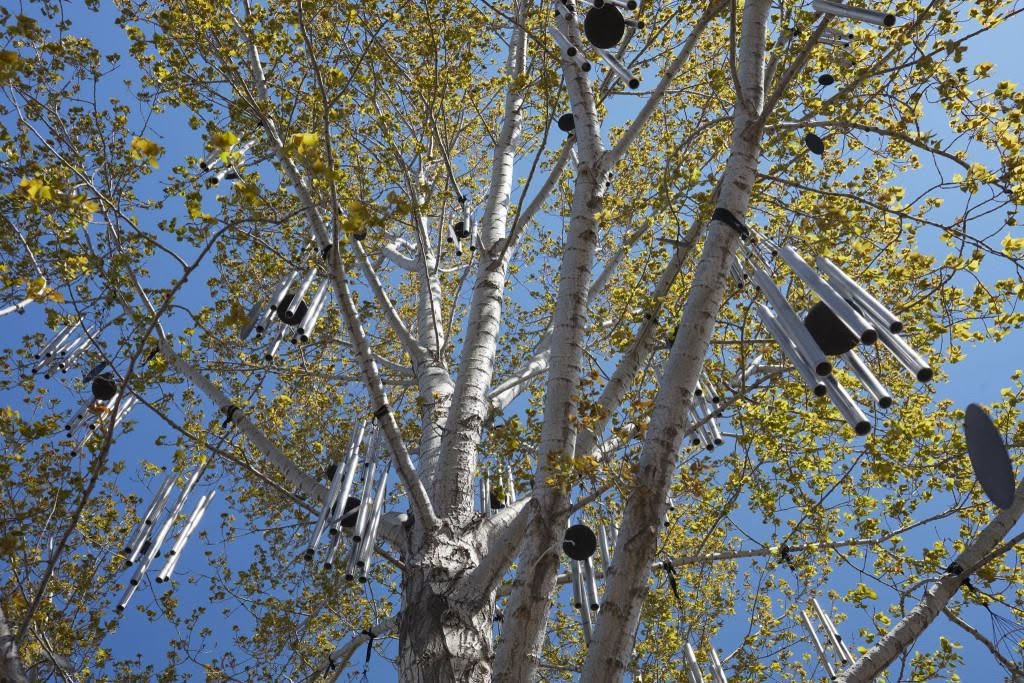
I loved that immediately. More than loved it, probably. I was overcome by the beauty of the idea that the wind was playing it. Every note was there, held in possibility, and the air itself became the performer. This isn’t a sculpture, like so many other works of this scale, that stands silent and stately waiting to be admired. It’s a work of art that only exists when it’s observed. Without a visitor to see the movement in the tree and to hear the notes of music, Wind Chime, the work of art, doesn’t exist.
That makes the encounter different from most museum experiences. Usually, the object survives you. You come and go. It remains, waiting for the next visitor to stand in more or less the same place and have more or less the same chance of understanding it. Huyghe’s piece resists that arrangement. You can stand there twice, but you’ll never see the same work twice. Come back the next day and the work won’t repeat itself for your benefit. It can’t. The air may move differently or barely move at all. A sound you heard might scatter the next time, or fail to arrive, leaving you with the tree, the chimes, and the strange feeling that the piece has withheld itself. It made me feel less like a viewer than a witness to something unrepeatable.
The musical portion comes from composer John Cage’s Dream, a quiet 1948 piano piece written for Merce Cunningham’s solo dance of the same name after Cunningham had already planned its structure. Huyghe’s chimes contain every note of Cage’s score, but it’s played on a different instrument here. The garden becomes the instrument, or maybe the stage, or maybe both. Cage, who spent so much of his life asking listeners to hear chance and environment differently, feels especially present and well-represented in this posthumous collaboration.
The Minneapolis Sculpture Garden is already a place where art has to negotiate with weather, foot traffic, and the ordinary public life moving around it. Outdoor sculpture can’t control the room because there’s no room to control. That’s one of the reasons this piece works so beautifully outdoors. Every element of that environment, and its interaction with the sculpture, IS the sculpture.
I stood there listening, and for once I didn’t feel the usual pressure to interpret quickly. I didn’t need to decide whether I “got it.” The piece asked me to notice the branches, the moving air, the slight metallic shimmer above my head, the fact that what I was hearing hadn’t existed a moment before and would never exist the same way again.
The piece debunks the idea that art should be the same for everyone at every hour. It depends on timing, weather, attention, and luck. That feels true to how we actually encounter art, though museums sometimes do their best to pretend otherwise. We like to imagine that a work has a fixed meaning waiting to be extracted by the properly informed viewer. Read the wall text, look at the date, absorb the context, nod in a thoughtful way, and congratulations, you have completed culture.
Some works expose the inadequacy of that approach. Huyghe’s chimes are out in the garden, exposed to weather, interruption, and whatever the air happens to be doing. The piece changes because the day changes. A few seconds later, the wind moves differently, the sound gathers somewhere else, and you’re no longer quite the same person who first stopped under that tree.
I keep returning to the fact that the piece I heard was made of that day’s wind and my attention to it. It existed for the time I stood there, and then it was gone. I found that unbelievably moving. In fact, had you been there on that day and looked closely, you might have noticed that I couldn’t keep tears out of my eyes.
I knew when I decided to write about Wind Chime that part of the piece would escape me the moment I tried to turn it into an article. That sounds convenient, I know. Writer discovers the limits of language, bravely continues typing anyway. The limitation, though, feels built into the work. Huyghe gave Cage’s music to the weather, and the experience of weather isn’t fully transmissible just because some visitor had a feeling under a tree. Sure, a photograph can show the chimes, and a few sentences can tell you what I thought I heard. Neither can quite capture the moment when the sound first gathered above me and I understood, not as an idea but as an experience, that the air itself was performing a work of art.
I think of it less as an object than as a small performance I happened to catch. Not performance in the theatrical sense, with curtains and applause and someone sweating under stage lights. Performance as an event: a temporary arrangement of matter, sound, attention, and time. The wind passed through the chimes, and for a little while, Cage’s notes were everywhere at once. Not played with fidelity, at least not in the traditional sense. Released.
I don’t want to oversell the moment. No one levitated. A museum guard didn’t appear from behind a hedge to whisper, “At last, you understand contemporary art.” It was quieter than that. I stood under a tree and listened to the wind make music from someone else’s score. Then I walked away knowing I would never hear that exact version again.
That’s enough.
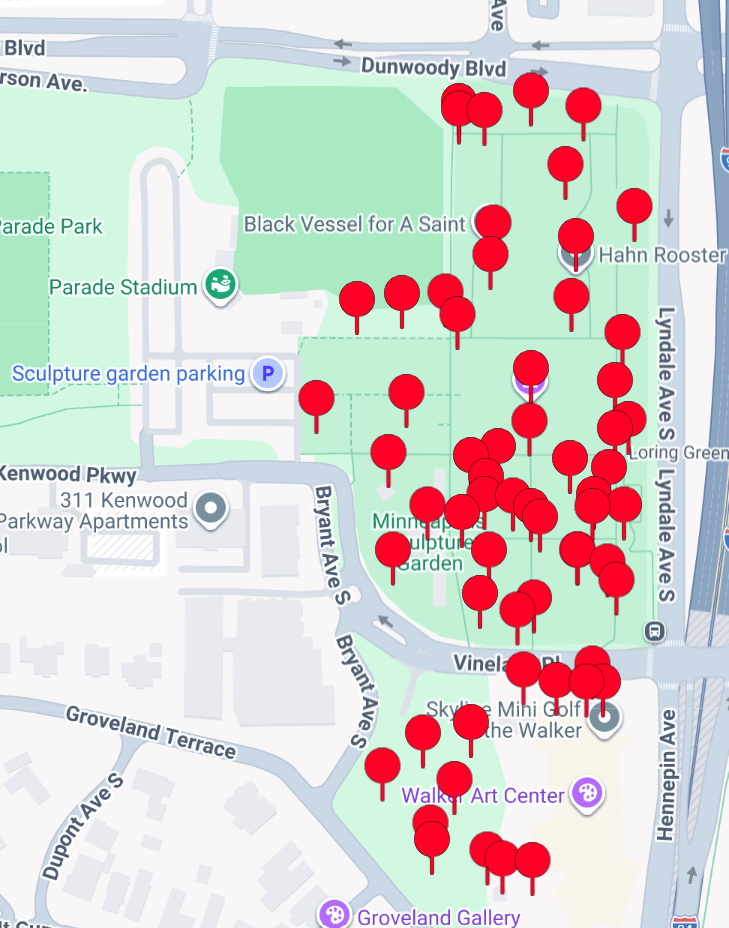
The Minneapolis Sculpture Garden is free to visit and open daily, which makes it an easy recommendation even if you only have a short window in the city. No tickets are required for the garden. Give yourself enough time to wander rather than treating it like a checklist. Spoonbridge and Cherry will probably pull you in first, and fair enough, but after that, let the quieter works have a chance.
For Wind Chime (after “Dream”) specifically, the most important practical advice is simple: don’t rush. The piece depends on wind, so your visit may be subtle, dramatic, or nearly silent. That uncertainty is the experience, not a factor to be managed. Stand under the tree for a few minutes before deciding what has or hasn’t happened.
The garden is outdoors, so weather matters more than usual. A mild day with some breeze is ideal, not just for comfort but for the piece itself. Comfortable shoes also help, since the best way to experience the garden is by moving slowly through it rather than hurrying from one famous object to the next.
The Walker Art Center’s visit information is the best place to check current hours, parking, transit, and accessibility details before you go. The garden is easy to pair with a Walker visit, but it also works on its own as a free, open-air stop.
Bring a camera – but listen first. A photo will be useful later, especially if you’re trying to explain to someone why a set of chimes in a tree undid you emotionally in public. Still, the photograph is not the art. The art happens when the air moves.
* * *

Ryan T. Pozzi is a nonfiction author based in Council Bluffs, Iowa, whose work explores creativity, failure, myth, and reputation. He spent much of his creative career building arts and literary communities in Omaha and Lincoln, Nebraska. His forthcoming book, The Mess That Made Them: How History’s Greatest Artists Failed, Floundered, and Made Something Brilliant Anyway, will be published by Bloomsbury on September 3, 2026. Learn more and preorder at ryantpozzi.com.