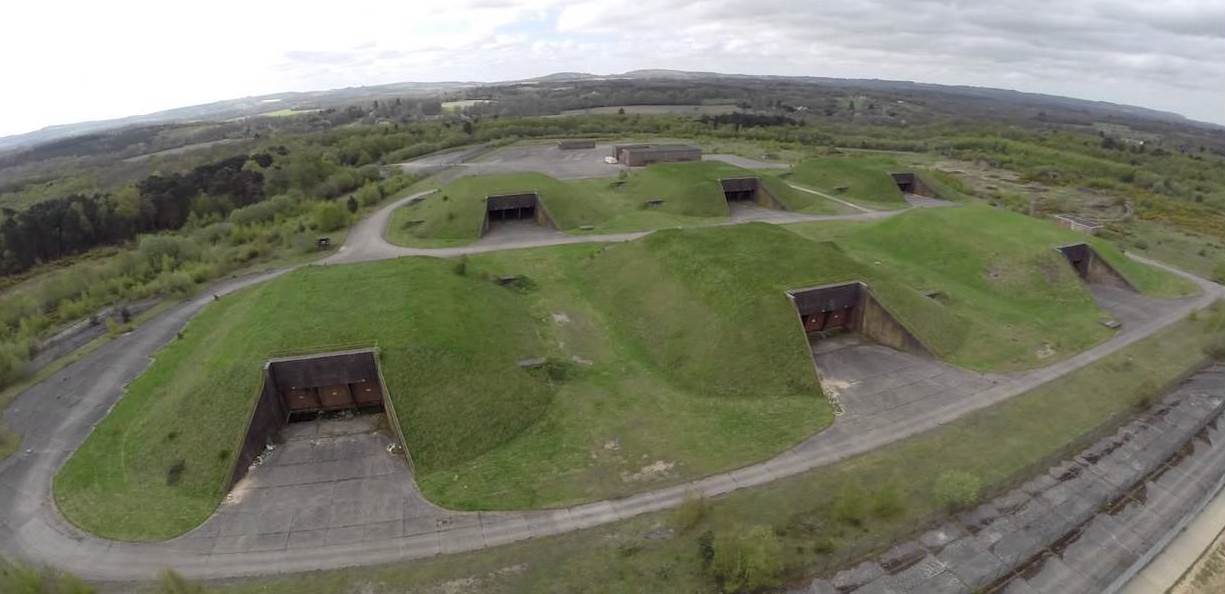

The closest I ever got to a Gryphon cruise missile was one morning when a C-5 Galaxy delivering a consignment of them almost took the chimney off my house. Having heard an unseasonal thundery sound, I got out of bed and opened the curtains to see the huge aircraft coming straight towards me. I can’t be sure but had the feeling the pilot was grinning at me. He was certainly close enough to notice that I wore no pyjamas. My house, you see, is just 1 ½ miles from Greenham Common near Newbury, England and in direct line with the runway.
Newbury is a market town (pop. 41,000) in the county of Royal Berkshire. It is approximately 50 miles to the west of London. It was home to Richard Adams whose book about an intrepid group of rabbits, Watership Down, is set there (maybe you remember the film and Art Garfunkel’s hit from it, Bright Eyes). Newbury is also the home town of Kate Middleton, wife of Prince William and the closest town to Highclere Castle, the real Downton Abbey. Lying between two areas of outstanding natural beauty it seemed an unlikely place to encounter the front line of the Cold War but in the 1980s that is what USAF Greenham Common was. In 1980 the UK government announced that 96 ground launched cruise missiles were to be based at Greenham. Security at the base was upgraded and work started on building six bunkers, each of which would house four launch vehicles capable of carrying four missiles, each of which could carry a war head with nine times the destructive power of the bomb that was dropped on Hiroshima. In September 1981 a group of women, children and pensioners walked from Cardiff in South Wales to Greenham in order to deliver a letter to the base commander protesting against the siting of the missiles and the proliferation of nuclear weapons generally. Setting up camp at the main gate, they were soon joined by other protestors. More and more came and in December 1982 an estimated 30,000 people joined hands to encircle the entire 9 miles perimeter of the base. Camps were set up at each of the base’s gates and the nature of the initially peaceful protest changed. Incursions into the base were made and security increased further. I personally recall the chill of driving down the country lane on its northern edge past barbed wire fences and watchtowers on which stood soldiers armed with machine guns. At night one could hear the chop, chop, chop of a helicopter then see a searchlight beaming down from it to sweep the perimeter. The sights and sounds I’d previously encountered on the border between East and West Germany had become a feature of this gentle corner of leafy Berkshire. Greenham Common made it to the nation’s tv news almost every night.
As it turned out the missiles didn’t stay all that long, the last one leaving in March 1991 though some of the protesters hung on for a further nine years. One sunny afternoon in July 1988 I decided to drive past the base on my way home from work. As I swung round a bend I was confronted by a sight that both surprised and delighted me. For there in front of me was the hammer and sickle of the Soviet Union on the tail fin of a jet liner parked on one of the pan handles by the control tower. This was seeing history in the making. The aircraft had brought in a team of Soviet inspectors as part of the INF treaty formulated by Presidents Reagan and Gorbachev. By 1992 the last USAF staff had left and in 1997 work started to restore the base to the common land it had been before WW2. Paradoxically, the restricted access to the common while the USAF were there had allowed flora and fauna to flourish undisturbed on the land and the common is now designated a site of special scientific interest.
A business park now stands where there were once hangars, workshops and living quarters on the southern flank of the base though the USAF Command Centre building along with its integral decontamination suite remains. The nearby bunkers are used to store new cars rather than missiles and occasionally serve as a film location (the 2015 Star Wars film The Force Awakens was shot there which gave a local light aircraft pilot a shock when he saw the Millenium Falcon and an X-wing sitting on the tarmac below him!) All that remains of what was once one of the longest military runways in Europe is the very centre of the common. On the northern side stands the 1952 control tower, now refurbished as a visitor centre comprising a dog friendly café, two exhibition suites and the glass cupola which provides magnificent views over the two square miles of the common and the beautiful downland beyond including Watership Down (yes, it really exists!)
An attractive, illustrated timeline on the ground floor provides an overview of events on the common from ancient times through to the English Civil War when Newbury was the site of a major battle, and on to WW1 when prototype tanks were tested there. On June 5th 1944 General Eisenhower drove from Allied Naval HQ in Portsmouth to Greenham, an event recreated by enthusiastic re-enactors to mark the 75th anniversary of D-Day. That evening he delivered the famous speech in which he told the men that, ‘The eyes of the world are upon you.’ Just before midnight he watched 81 C-47 Dakota aircraft take off at 11 second intervals to carry 1,430 paratroopers to France. Glider borne troops followed soon after.
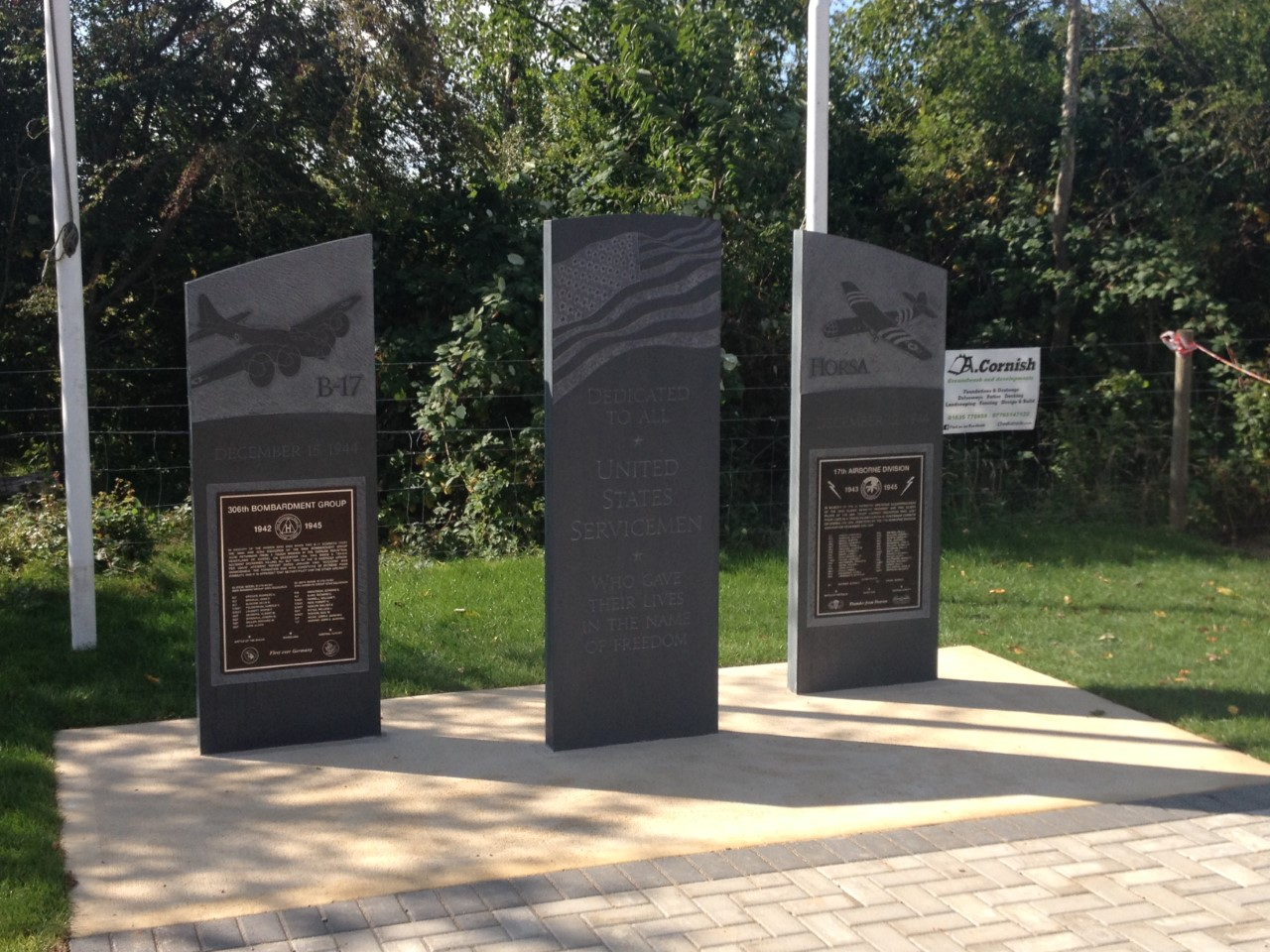
In September 1944, 145 C-47s towed gliders to Holland as part of Operation Market Garden. Greenham Common is just one of a number of bases in the area. Others include Membury and Ramsbury while villages such as Aldbourne will be familiar to devotees of the tv series Band of Brothers. Silhouettes of C-47s and Horsa gliders now fly in formation across the ceiling of the café. Although Greenham Common was never attacked in the war there was a loss of life there. In December 1944 a Horsa glider crashed during a training exercise. The 31 soldiers and two pilots on board were killed. Just three days later two B-17 Flying Fortress bombers were diverted to Greenham following a raid over Germany because of bad weather. They collided and 16 of the 20 crew members were killed. A striking memorial to the fallen was unveiled by Princess Ann in 2012. The memorial, which was originally sited in the business park, has now been relocated to the grounds of the control tower giving the site an added poignancy.
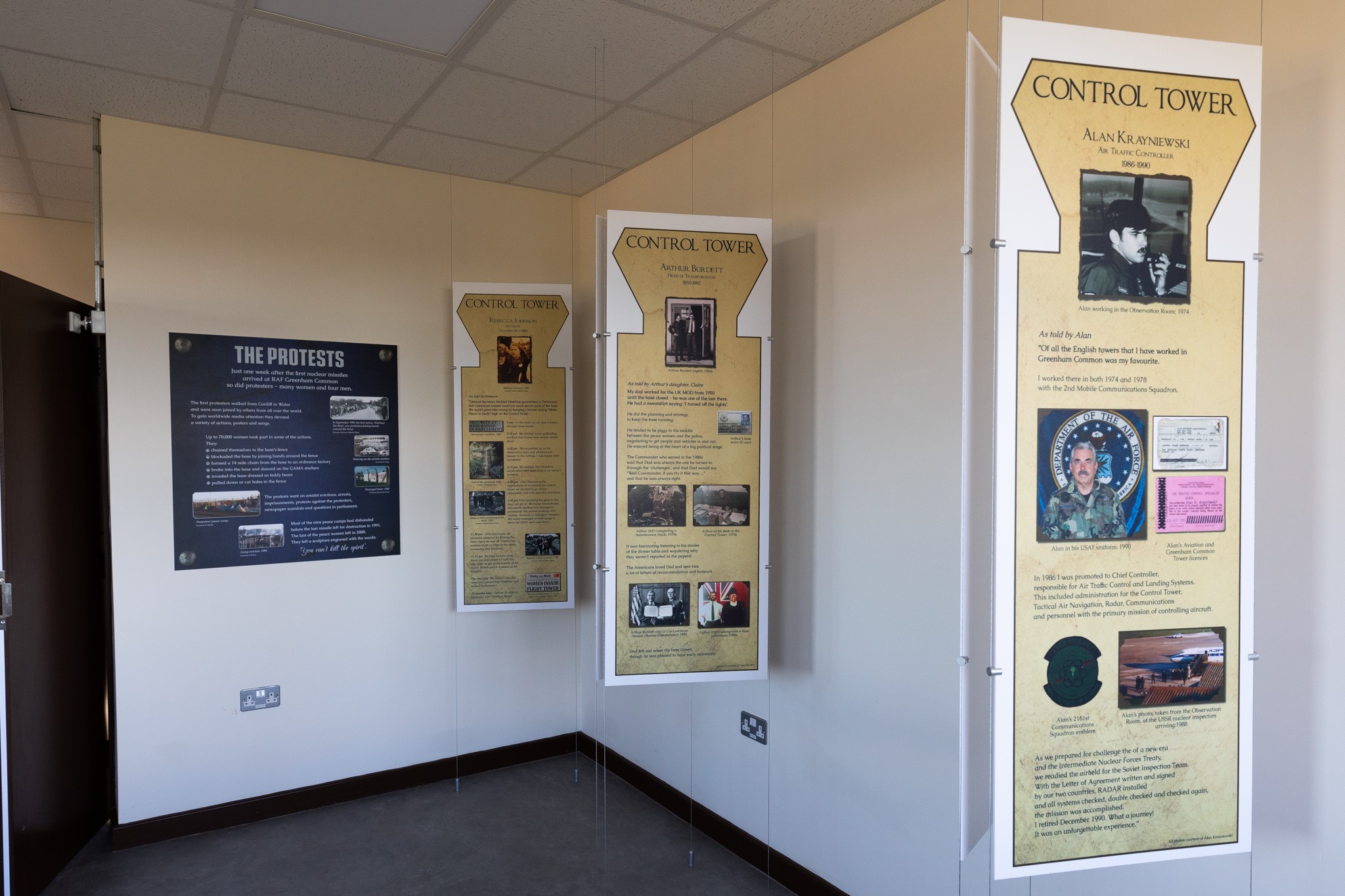
Panels in the first floor exhibition room document the part played by Greenham Common in WW2 and the Cold War. Contextual information on the nature of the Cold War and the proliferation of nuclear weapons segues neatly into the personal testimonies of USAF servicemen based there during the 1980s and some of the women who camped in protest outside its gates. A second room on this floor houses temporary displays which have, to date, included exhibitions on the natural environment of the common, photographs capturing the conditions experienced by the peace women, art inspired by the common and a commemoration of the 75th anniversary of D-Day.
The café is divided into two sections, one being designated dog friendly. The homemade cakes are rapidly achieving legendary status. A small selection of savoury snacks is also available at reasonable prices. Activity sheets designed to help younger visitors explore the tower and its history are provided free of charge. Volunteer guides are noted both for their friendliness and the depth and breadth of their knowledge. Guided walks across the common are available in the summer months. Starting at the tower, the walk takes in the historic runway, the decontaminations suite, the ‘fire plane’ that was used to train the fire and rescue services, the missile bunkers and ‘Blue Gate’ the last remaining site of one of the peace camps. The tower and guided walks score very highly on Trip Advisor. A programme of talks and performances runs throughout the year.
The philosopher George Santayana famously said, ‘Those who do not remember the past are condemned to repeat it.’ The control tower at Greenham Common was erected for one purpose but the directors and volunteers who give freely of their time, energy and expertise to running it are determined to have it serve a greater one. That is, to inform the young and remind the older visitors what happened on this spot of ground; to celebrate, commemorate and indeed enjoy. The common and adjacent woods are lovely places to walk. The tower is now embarking on the next phase of its development which is to extend the collection of oral histories and artefacts linked directly to the tower. They appreciate hearing from anyone who has had a connection to the tower, a story to tell, or something lying in a cupboard or drawer that they think may be of interest to our visitors.
Greenham Control Tower is open on Thursday and Friday mornings 10.30 – 13.30 and 9.30 – 16.00 on Saturdays and Sundays. There is no entrance fee to this small but intriguing attraction though donations boxes are housed in prominent positions. The building is wheelchair accessible and there is a disabled toilet. As a Grade 2 listed military building there is no lift to the exhibition rooms or observation deck. However, there is an interactive screen in the cafe that offers fascinating pictures from the tower’s history and a 360 degree view from the Observation Deck.
The tower is just to the south of Newbury town centre off the A339.
Website: www.greenhamtower.org.uk
Email: info@greenhamtower.org.uk
Facebook: https://en-gb.facebook.com/GreenhamControlTower/
Addendum:
To the outside eye it would appear that not a lot has been going on at Greenham Control Tower in recent weeks. However, quite a lot has been ticking away in the background. A special exhibition exploring the part Newbury and the surrounding area played in the Second World War has been prepared, the intention being to open it on May 8th to coincide with national celebrations of VE Day. The exhibition may hold some surprises for visitors. Parts for aircraft such as Spitfires and Mosquitos were manufactured in the town while Elliots Moulding and Joinery Co. were the principal manufacturers of the Horsa glider, many of which flew from Greenham Common to land airborne forces in Normandy and at Arnhem. The town was attacked three times, played an important role in D-Day and became home to, variously, evacuees, numerous Americans and PoWs. I have drawn on this local history and written a play called Half-light which focuses on one Newbury family’s experience of VE Day and the mixture of emotions it provoked. Inevitably, the exhibition and the performance of the play has been postponed but can assure readers that these things will happen. To slightly misquote Dame Vera, we know exactly where, though we don’t quite know when! But they will happen and we will celebrate not only Victory in Europe Day but hopefully sometime soon Virus Eradication Day.’ In the meantime I have been rehearsing my actors on line and we are making a short film which will be posted on the tower’s website on May 8th, VE Day itself. Called Eight on the 8th the film captures the personal stories of the eight characters of Half-light and presents them as a series 14 line monologues. We hope that people will feel free to download the film. Perhaps it will evoke memories of the day and remind us all how everyone has an interesting story to tell.
* * *

Andy Kempe is Emeritus Professor of Drama Education, University of Reading, UK. He has lived in Newbury since 1982 and followed the changes at Greenham with fascination and wonder over his time there. In 2017 he took part in the community theatre event ‘Greenham: One Hundred Years of War and Peace’ which played for two nights to over 6,000 people.