
In May 2021 I became the Heritage Officer at Englesea Brook Chapel and Museum of Primitive Methodism. I have a long-standing interest in Methodist history, having grown-up in Epworth, the birthplace of the founders of Methodism, John and Charles Wesley. Having volunteered and worked for years at Epworth Old Rectory, the Wesleys’ childhood home, I decided a move to Englesea Brook would be the perfect next step in my career.
Englesea Brook is one of four Methodist Heritage sites in the UK (the others are Epworth Old Rectory, John Wesley’s New Room in Bristol, and The Museum of Methodism & John Wesley’s House in London). Set in a picturesque hamlet in rural Cheshire, surrounded by farmland, gently rolling hills and hiking routes (including the Two Saints Way between Chester and Lichfield), it is a beautiful place to work and an idyllic place to visit.
We are the only museum of the 19th century Primitive Methodist movement, which began in 1807. Hugh Bourne and William Clowes, the co-founders of the movement, felt the Wesleyan Methodists had moved away from John Wesley’s original aims to minister to the poor. Becoming an established Church following Wesley’s death in 1791, they wanted to be seen as ‘acceptable’. Wesley had travelled across the country preaching outdoors to any crowds that gathered. The Wesleyans had stopped this practice due to the British government’s fears that, in the wake of the French Revolution, working-class groups gathering in large numbers would be planning revolt. Bourne and Clowes believed it was important to continue itinerant ministry. In 1807 the first Camp Meeting was held at Mow Cop, Staffordshire. Bourne, Clowes and other early ‘Prims’ were expelled by the Wesleyan Methodists for this and other Camp Meetings, and their itinerant preaching.
The hearts and minds of miners and millworkers, farm labourers and fishermen were inspired by ‘Freedom, Equality and Fraternity’. Women became travelling preachers. A passion for social justice led many to become trade union leaders and MPs. Preaching began in Englesea Brook in 1811, in the cottage of Sarah Smith, a farm labourer’s wife (the cottage can still be seen today, a short walk from the museum, but is a private residence). A Primitive Methodist society was formed, and continued to meet in people’s homes, until the Chapel was built in 1828. It was substantially rebuilt in 1832, because it had become too small for their congregation. We hold monthly Heritage Services and visitors are welcome to explore the Chapel and Museum, where we exhibit items from our extensive collection of Primitive Methodist artefacts, including a selection from the largest collection of religious banners in the UK. You can see the graves of Hugh Bourne and other Prims in our graveyard.
I can take you on a ‘tour’ of the site, starting in the Chapel, moving through the museum, into the cottage where we have a small shop and tearoom, and give you a peek behind-the-scenes at our Collections Store.
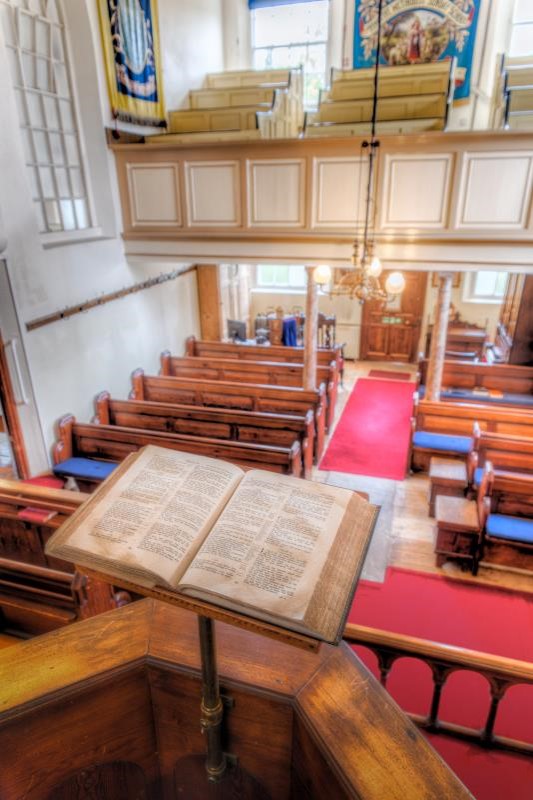
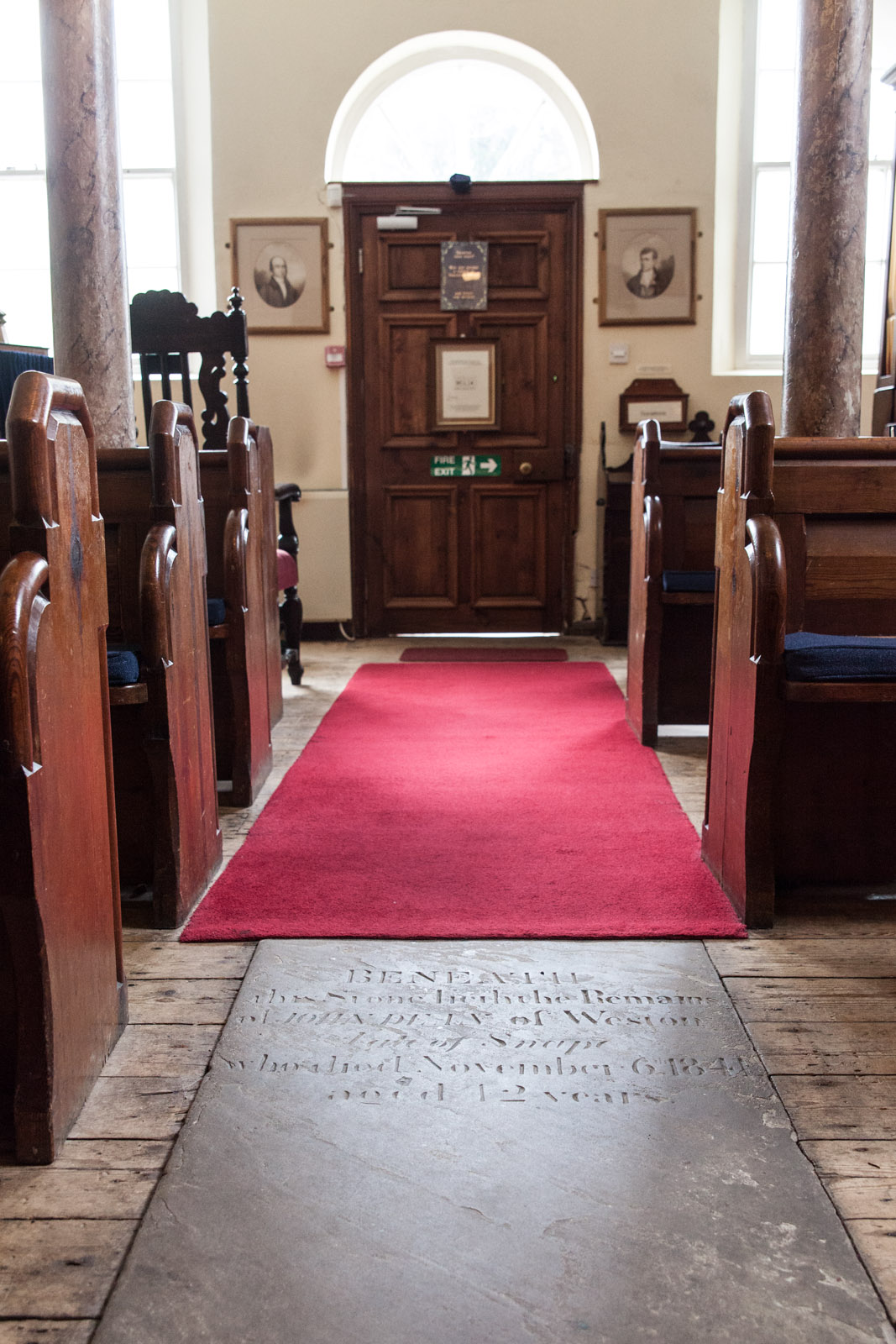
When outside the Chapel you may be surprised by its appearance. The façade looks like a house. As the Prims started by preaching in people’s homes, they wanted their Chapel to continue to have a ‘homely’, welcoming feel, and not look imposing to the working-class, who often felt excluded from the established Church of England. Once you enter the door up a couple of steps (if you require an accessible entrance this is available into the museum) you will look down the aisle between the pews to the pulpit. The pews and pulpit were not original but were added in the late 19th century, when, like the Wesleyans nearly a century earlier, the Prims had become more established and wanted to be seen as respectable. Nearer to you in the immediate foyer you will find an organ to your left, as well as two harmoniums. Prims and other Methodists were known (and still are) for their love of hymn-singing and these instruments exemplify this. Harmoniums were often portable (although they do not always look it) and would be taken to different chapels and gatherings. To the right of the door is a cupboard. It is plain and simple but important to our history. It belonged to Hugh Bourne and it is believed that, as he was a carpenter, he made it himself. It stood in the home of Hugh and his brother, James, at Bemerseley Farm, where they also had their printing press. Hugh was keen to improve education and printed tracts and books for this purpose.
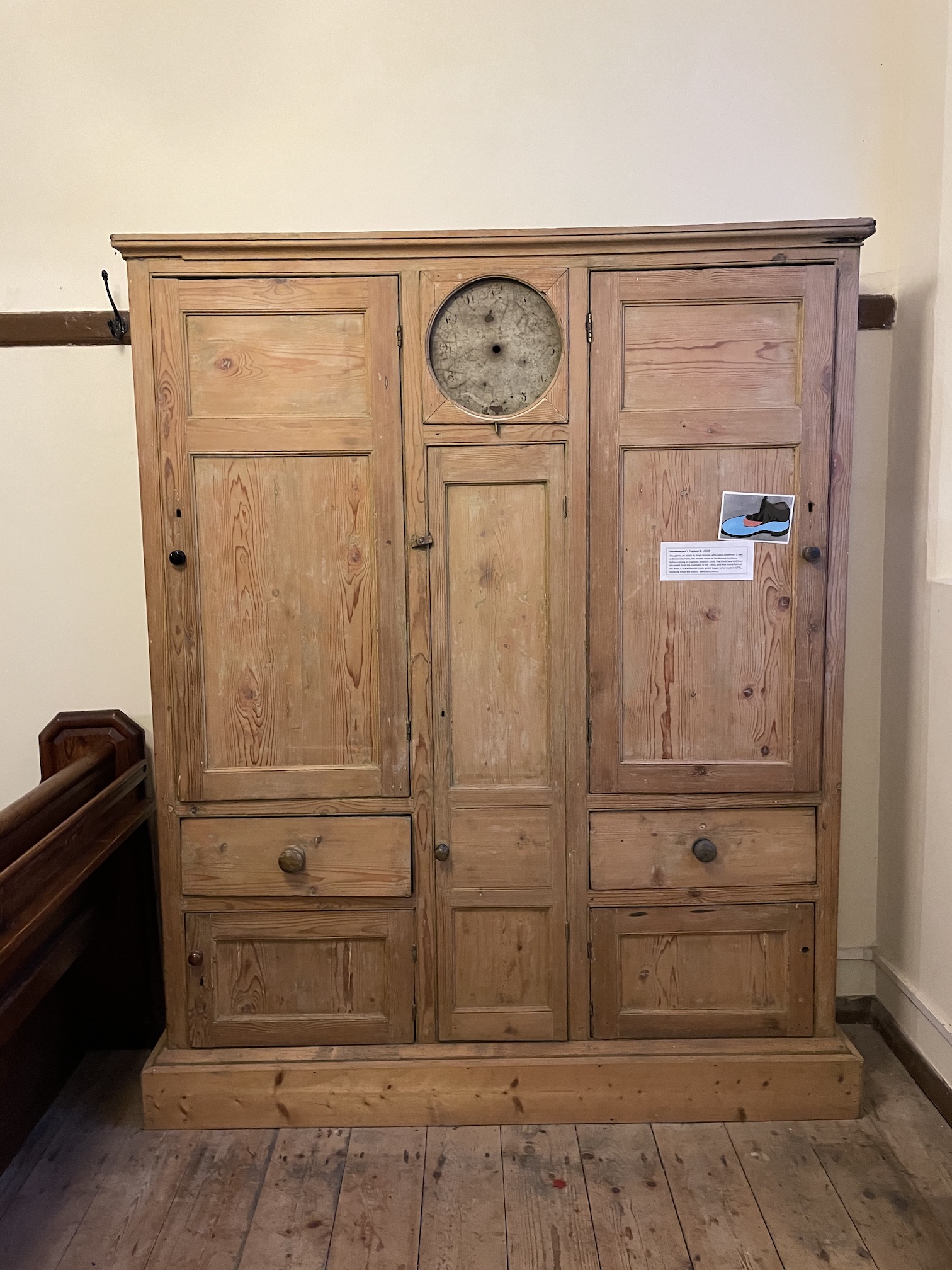
As you go further into the Chapel you will find a staircase up to the gallery, where you can look across the Chapel to the large windows above the pulpit. Back down on the ground floor, as you walk towards the pulpit, you will find a gravestone in the floor marking the resting place of John Dean of Weston. It is extremely rare for a grave to be found within a Methodist chapel. At the time Dean died the Parish of Weston would not allow him to be buried in the Parish church graveyard due to the established Church’s distrust of the Prims.
From the Chapel you will go up two steps to the right of the pulpit into the museum (if you require a ramp, please ask museum staff and volunteers and they can attach this to the steps for you). The museum is housed in the Hugh Bourne Memorial School, the Sunday School building built in 1914. It is here that our exhibitions are displayed. Currently in place are information panels explaining Prim involvement in social justice, including 19th century campaigns for fairer wages, better living and working conditions for the poor, and involvement in trade unions. From October 2021-October 2022 we have a black history exhibition, Equal?, which explores the stories of black Primitive Methodists, including Samuel Barber, a local preacher in Tunstall in the early 1800s. The story continues with an examination of Prim missionary work in the UK and Africa and grapples with the difficult questions surrounding this. Several artefacts are displayed, including missionary collecting boxes and artefacts brought back from Nigeria by missionaries.
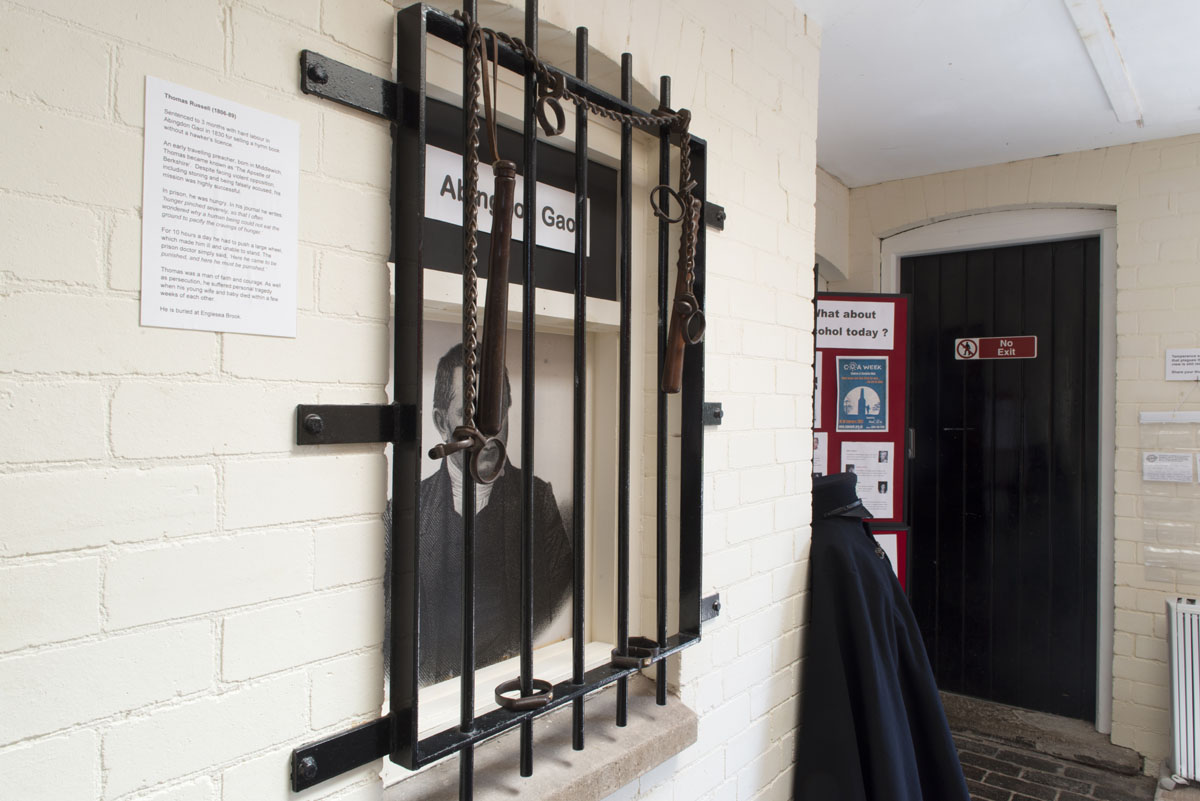
As you leave the main room in the museum you will go up two steps into the ‘Bourne Room’. Displayed here are several artefacts that belonged to Hugh Bourne and William Clowes, including several of their walking sticks, which must have travelled many miles with them during their itinerant preaching. Next you will enter the ‘Bier Room’, where you will find a large funeral bier. This illustrates Hugh Bourne’s funeral procession, which brought him to his final resting place at Englesea Brook. Bourne’s grave can be seen in the graveyard across the road from the Chapel. Built into the wall is a jail cell, containing the portrait of Thomas Russell, who was sentenced to three months hard labour in Abingdon Gaol in 1830 for selling hymn books without a hawker’s licence. Prims were often arrested for their support of social causes. You can open the door behind the cell and have your photograph taken in jail!
Once you have explored the Chapel and museum to your heart’s content you will exit through the door in the Bier Room, which will lead you down a covered path to the cottage. Methodists are well known for their skills at making cups of tea and there will be volunteers on hand to make you a lovely warming cuppa (coffee is available if tea is not your preference). There is a small shop, where you can find books, postcards, and souvenirs.
In April 2019 our purpose-built Collections Store was opened. Designed as an open store, we hold tours throughout the year on different themes. If your visit does not coincide with a scheduled tour, our staff and volunteers are happy to take you round upon request. Here you will find our banner collection, as well as a plethora of pottery from different chapels – including an entire dinner service made for a chapel in Tunstall – and portraits of notable Prims. You will also get a surprise when you open some of the drawers!
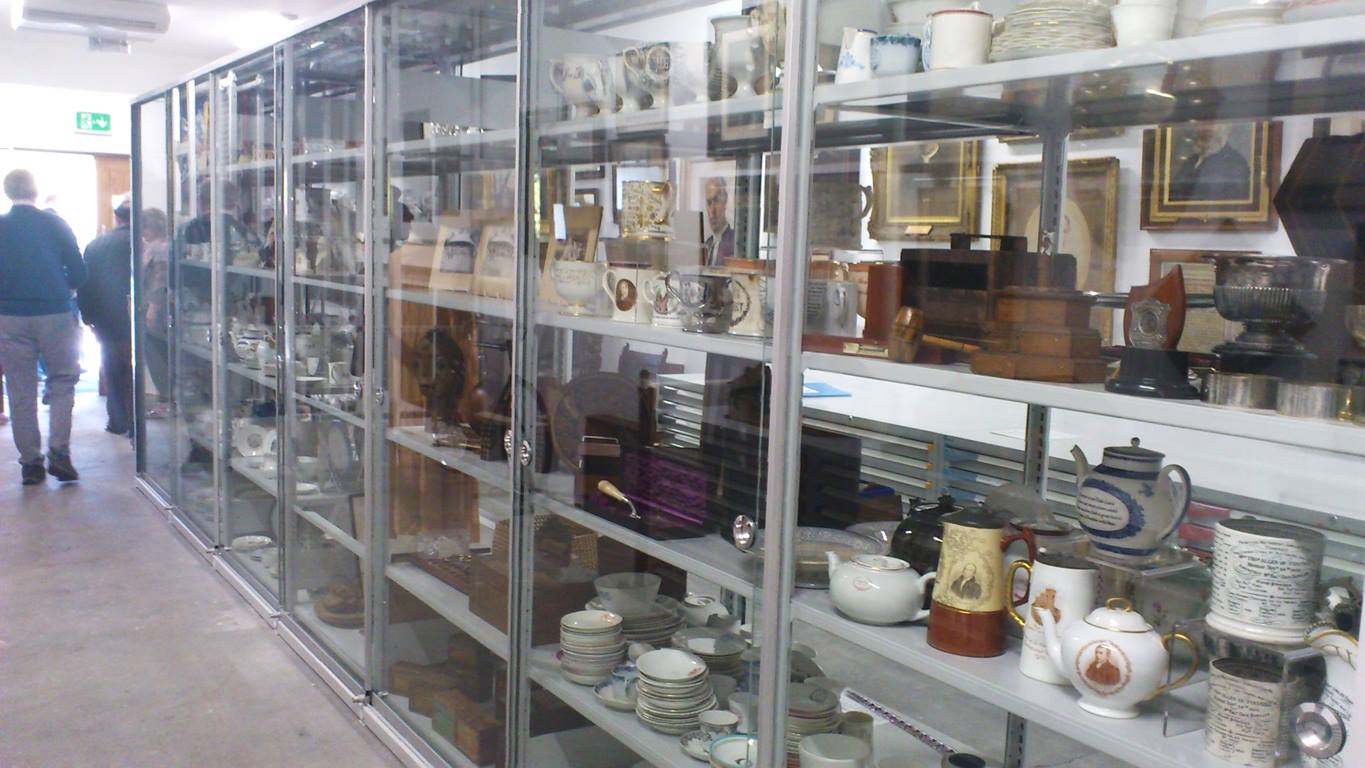
The store is often the last stop on your visit. A visit of the full site usually takes an hour, but you can spend as long as you like exploring. We look forward to welcoming you to this beautiful corner of Cheshire soon!
2022 is the 250th anniversary of the birth of Hugh Bourne. Numerous exciting events are in the pipeline, including an in-house exhibition, a travelling exhibition, tours of the Collections Store, a talks series, conference, and restoration of Bourne’s grave. Keep an eye on our website and social media for updates, including dates and times of all the events.
Throughout the year we hold Heritage Talks, where we welcome guest speakers to explain fascinating aspects of Prim history. During the COVID-19 pandemic these went online via Zoom and will remain in this format for the foreseeable future. We also have monthly Heritage Services in the Chapel, to which all are welcome. See our website and social media for details.
We welcome school groups onsite, allowing children to learn about the history of their local area. Our Learning Officer organises these and her contact details can be found on our website.
As well as school groups, other groups who would like to visit are very welcome and can contact our Administrator to organise this (see website for contact details).
Opening times:
April-October:
Thurs-Sat, 11am-3pm
Sun, 2pm-4pm
August:
Tues-Sat, 11am-3pm
Sun, 2pm-4pm
Nov-March:
Closed. It is very cold in the Chapel and museum in these months!
Admission:
Admission is free, but donations are welcome.
Transport:
We are easily accessible by car, with brown signs pointing the way. There is a carpark across the road from the museum, as well as bike racks.
Bus 85, which runs between Crewe and Newcastle-under-Lyme, stops a short ten-minute walk from the museum.
Accessibility:
There is an accessible entrance into the museum and a ramp is available from the museum into the Chapel. If you require the ramp, please let staff and volunteers know and we are happy to put this in place for you. An accessible toilet is available. There is an accessible parking space in the carpark.
If you would like to discuss your requirements, please don’t hesitate to contact us, via phone or email. All our contact details are available on our website.
Websites and Social Media:
Website - Englesea Brook Chapel and Museum
My Primitive Methodists (community history website) - My Primitive Methodists | Sharing stories, photos, memories and research
Facebook - @EngleseaBrookChapel
Twitter - @EngleseaBrook
Instagram - @engleseabrook
YouTube – Englesea Brook Chapel & Museum of Primitive Methodism
* * *
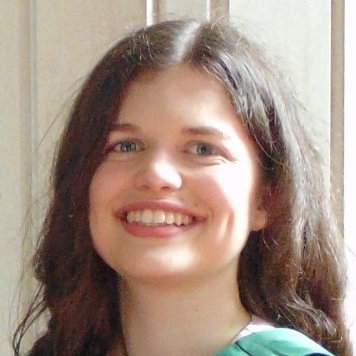
ave a BA in Classical Literature and History from the University of Leeds, and an MA in Museum Studies from the University of Leicester. I have been involved in the museum sector since I was seventeen, volunteering as a tour guide at Epworth Old Rectory. Knowing that my career goal was to work in museums, hands-on with history, I went on to curate an exhibition at Epworth Old Rectory in 2017-2018, was part of their collections care team, and in summer 2019 joined their staff as Website and Social Media Assistant.
In November 2018 I spent a month with The Shakespeare Birthplace Trust in Stratford-upon-Avon, playing Anne Hathaway as First-Person Interpreter at Anne Hathaway’s Cottage.
I completed my MA Museum Studies from September 2019-September 2020. Following this I joined the staff of Englesea Brook in May 2021, where I am lucky enough to care for the incredible collection and curate exhibitions as Heritage Officer.